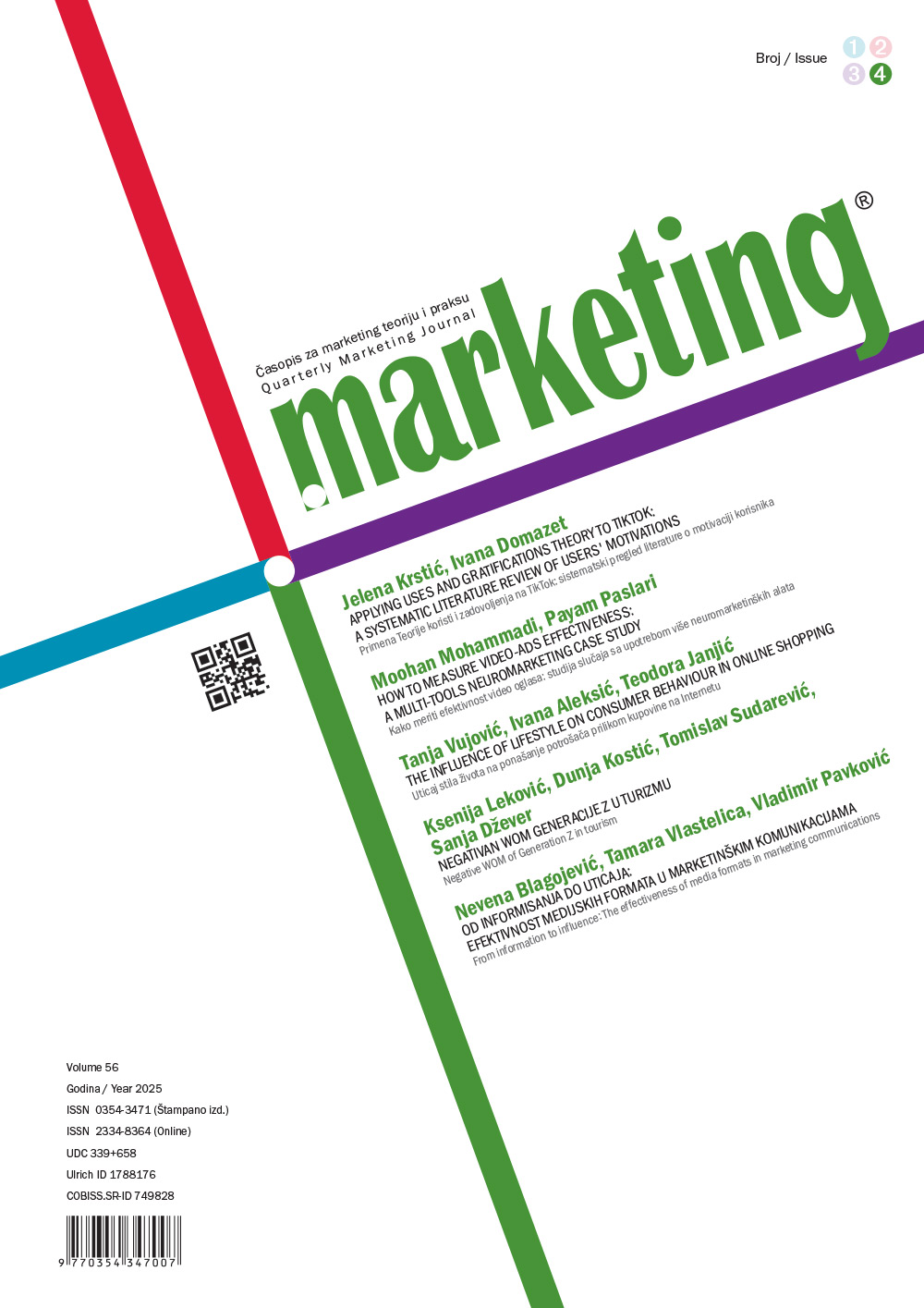
Primena Teorije koristi i zadovoljenja na TikTok: sistematski pregled literature o motivaciji korisnika
Applying Uses and Gratifications Theory to TikTok: A systematic literature review of users‘ motivations
Apstrakt
U radu je prikazan sistematski pregled postojeće literature koja se bazira na Teoriji koristi i zadovoljenja (eng. Uses and Gratifications Theory – UGT) kako bi se objasnili motivi korisnika za korišćenje platforme TikTok. Cilj rada je identifikovanje i klasifikovanje glavnih motiva koji podstiču angažovanje korisnika na ovoj društvenoj mreži, kao i pružanje uvida u istraživačke trendove, geografsku rasprostranjenost studija na ovu temu i metodološke pristupe koji su primenjeni u relevantnoj literaturi. Analiza odabranih naučnih radova dovela je do identifikacije deset dominantnih klastera korisničkih zadovoljenja: kognitivna zadovoljenja, afektivna zadovoljenja, socijalna/relaciona zadovoljenja, samoizražavanje/samospoznaja, relaksacija, priznanje i slava, bekstvo od stvarnosti, hedonistička zadovoljenja, praćenje trendova/novina i pokretanje akcije i interaktivnost. Ovaj pregled doprinosi dubljem razumevanju ponašanja korisnika na TikToku i pruža osnovu za buduća istraživanja u ovoj oblasti. Na kraju, u radu je ukazano na praznine u postojećoj literaturi i predložene su smernice za buduća teorijska i empirijska istraživanja.
Abstract
This paper provides a systematic review of the existing literature that utilizes Uses and Gratifications Theory (UGT) to explain users‘ motivations for using the TikTok platform. The aim of the paper is to identify and classify the main motives that drive user engagement on this social network, as well as to provide an insight into the research trends, geographical distribution of studies on this topic and the methodological approaches that have been applied in the relevant literature. An analysis of selected scientific papers led to the identification of ten dominant clusters of user gratifications: cognitive, affective, social/relationship, self-expression/self-identity, relaxation, recognition and fame, escapism, hedonistic, trendiness/novelty and agency and interactivity. This overview contributes to a deeper understanding of user behavior on TikTok and provides a basis for future research in this area. Finally, the paper points out the gaps in the existing literature and suggests guidelines for future theoretical and empirical research.
Reference
- Abbasi, A.Z., Ayaz, N., Kanwal, S., Albashrawi, M. and Khair, N. (2023). TikTok app usage behavior: the role of hedonic consumption experiences. Data Technologies and Applications, 57(3), 344-365.
https://doi.org/10.1108/DTA-03-2022-0107 - Alhabash, S., Chiang, Y.H. and Huang, K. (2014). MAM & U&G in Taiwan: differences in the uses and gratifications of Facebook as a function of motivational reactivity. Computers in Human Behavior, 35, 423-430. https://doi.org/10.1016/j. chb.2014.03.033
- Alhabash, S., Smischney, T. M., Suneja, A., Nimmagadda, A. and White, L. R. (2024). So similar, yet so different: How motivations to use Facebook, Instagram, Twitter, and TikTok predict problematic use and use continuance intentions. SAGE Open, 14(2). https://doi.org/10.1177/21582440241255426
- Bucknell Bossen, C. and Kottasz, R. (2020). Uses and gratifications sought by pre-adolescent and adolescent TikTok consumers. Young Consumers: Insight and Ideas for Responsible Marketers, 21(4), 463–478. https://doi.org/10.1108/yc-07-2020-1186
- Chaihanchanchai, P. and Anantachart, S. (2024). Empirical evidence of factors underlying TikTok usage: A serial mediation analysis. Journal of Marketing Communications, 1–25. https://doi.org/10.1 080/13527266.2024.2419024
- Chan, M. (2014). Social identity gratifications of social network sites and their impact on collective action participation. Asian Journal of Social Psychology, 17(3), 229-235. https://doi.org/10.1111/ajsp.12068
- Chen, H., Ma, D. and Sharma, B. (2024). Short video marketing strategy: evidence from successful entrepreneurs on TikTok. Journal of Research in Marketing and Entrepreneurship, 26(2), 257-278.
https://doi.org/10.1108/JRME-11-2022-0134 - Cleofas, J. V., Albao, B. T. and Dayrit, J. C. S. (2022). Emerging adulthood Uses and Gratifications of social media during the COVID-19 pandemic: A mixed methods study among Filipino college students. Emerging Adulthood, 10(6), 1602-1616. https://doi.org/10.1177/21676968221128621
- Cuesta-Valiño, P., Gutiérrez-Rodríguez, P. and Durán-Álamo, P. (2022). Why do people return to video platforms? Millennials and Centennials on TikTok. Media and Communication, 10(1).
https://doi.org/10.17645/mac.v10i1.4737 - (2024). Digital 2024: Global Overview Report. Retrieved 5/9/2025 from https://datareportal.com/reports/digital-2024-global-overview-report
- Deng, T., Vargas-Bianchi, L. and Mensa, M. (2023). Cross-Cultural comparison of TikTok uses and gratifications. Behaviour & Information Technology, 43(12), 3047–3059. https://doi.org/10.1080/014492 9X.2023.2270534
- Dias, P. and Duarte, A. (2022). TikTok practices among teenagers in Portugal: A Uses & Gratifications approach. Journalism and Media, 3(4), 615-632. https://doi.org/10.3390/journalmedia3040041
- Domazet, I. and Marjanović, D. (2024). Digital Progress and information society: Evidence from EU Countries and Serbia. In: B. Verma, B. Singla and A. Mittal (Eds). Driving Decentralization and Disruption with Digital Technologies (pp. 1-20). Hershey: IGI Global.
- Dong, Z. and Xie, T. (2024). Why do people love short-form videos? The motivations for using Chinese TikTok (Douyin) and implications for well-being. Current Psychology, 43, 22283–22296. https://doi.org/10.1007/s12144-024-05927-4
- Duarte, A. and Dias, P. (2021). TikTok: uses and motivations among teenagers in Portugal. Chasqui. Revista Latinoamericana De Communication, 147, 81-102.
- Ezumah, B.A. (2013). College students’ use of social media: Site preferences, uses and gratifications theory revisited. International Journal of Business and Social Science, 4(5), 27-34.
- Falgoust, G., Winterlind, E., Moon, P., Parker, A., Zinzow, H. and Madathil, K. C. (2022). Applying the uses and gratifications theory to identify motivational factors behind young adult’s participation in viral social media challenges on TikTok. Human Factors in Healthcare, 2.
https://doi.org/10.1016/j. hfh.2022.100014 - Gan, C. and Wang, W. (2015). Uses and gratifications of social media: a comparison of microblog and WeChat. Journal of Systems and Information Technology, 17(4), 351-363.
https://doi.org/10.1108/JSIT-06-2015-0052 - Garcia, M. B. (2024). Watching exercise and fitness videos on TikTok for physical education: motivation, engagement, and message sensation value. Journal of Teaching in Physical Education, 44(3), 537-550. https://doi.org/10.1123/jtpe.2024-0084
- Gu, L., Gao, X. and Li, Y. (2022). What drives me to use TikTok: A latent profile analysis of users’ motives. Frontiers in Psychology, 13. https://doi.org/10.3389/fpsyg.2022.992824
- Ifinedo, P. (2016). Applying uses and gratifications theory and social influence processes to understand students’ pervasive adoption of social networking sites: Perspectives from the Americas. International Journal of Information Management, 36(2), 192-206. https://doi.org/10.1016/j.ijinfomgt.2015.11.007
- Jin, H., Chen, T. and Shi, H. (2024). Beyond the fitness: A big data analysis of home exercisers demand. SAGE Open, 14(3). https://doi.org/10.1177/21582440241274533
- Jung, Y., Kim, T., Lee, S., Min, S. and Sung, Y. (2025). Short made them powerful: exploring motivations and problematic uses of TikTok. Cyberpsychology, Behavior, and Social Networking, 28(2), 90–97. https://doi.org/10.1089/cyber.2024.0328
- Kamboj, S. (2020). Applying uses and gratifications theory to understand customer participation in social media brand communities: Perspective of media technology. Asia Pacific Journal of Marketing and Logistics, 32(1), 205-231. https://doi.org/10.1108/APJML-11-2017-0289
- Katz E., Blumler J. G. and Gurevitch M. (1973). Uses and gratifications research. Public Opinion Quarterly, 37(4), 509–523. https://doi.org/10.1086/268109
- Kostić-Stanković, M., Štavljanin, V. and Krstić, J. (2024). Marketinška komunikacija: Tradicionalna i digitalna perspektiva. Beograd: Fakultet organizacionih nauka.
- Krstić, J. (2025). Evaluating corporate reputation in the digital environment: Insights from a systematic literature review. In: A. Erturk, M. Özşahin and V. Simović (Eds.). Human-Centric, Sustainable, and Resilient Organizations in the Digital Age (pp. 235-256). Hershey: IGI Global.
- Krstić, J. and Zuber, Lj. (2024). Theoretical frameworks of the influence of social media on the attitudes and behavior of users. In D. Kojić and D. Sredić (Eds). Proceedings of XIII International Conference on social and technological development (pp. 580-589). Banja Luka: University PIM.
- Ku, Y.-C., Chu, T.-H. and Tseng, C.-H. (2013). Gratifications for using CMC technologies: a comparison among SNS, IM, and e-mail. Computers in Human Behavior, 29(1), 226-234.
https://doi.org/10.1016/j.chb.2012.08.009 - Kyei-Gyamfi, S. (2024). The benefits of social media among children aged 8 to 17 in Tema Metropolitan area in Ghana. SAGE Open, 14(3). https://doi.org/10.1177/21582440241278546
- Lazić, M., Domazet, I. and Vukmirović, V. (2022). Global pandemic and digital marketing: Trends and perspectives. Marketing, 53(2), 143-152. https://doi.org/10.5937/mkng2202143L
- Lazić, M., Vukmirović, V. and Domazet, I. (2023). Digital marketing as a tool for inclusive employment. Marketing, 54(4), 271–277. https://doi.org/10.5937/mkng2304271l
- Malik, A., Dhir, A. and Nieminen, M. (2016). Uses and gratifications of digital photo sharing on Facebook. Telematics and Informatics, 33(1), 129-138. https://doi.org/10.1016/j.tele.2015.06.009
- Mao, E. (2022). How live stream content types impact viewers’ support behaviors? Mediational analysis on psychological and social gratifications. Frontiers in Psychology, 13.
https://doi.org/10.3389/fpsyg.2022.951055 - Miranda, S., Trigo, I., Rodrigues, R. and Duarte, M. (2023). Addiction to social networking sites: Motivations, flow, and sense of belonging at the root of addiction. Technological Forecasting and Social Change, 188. https://doi.org/10.1016/j. techfore.2022.122280
- Montag, C., Yang, H. and Elhai, J. D. (2021). On the psychology of TikTok use: A first glimpse from empirical findings. Frontiers in Public Health, 9. https://doi.org/10.3389/fpubh.2021.641673
- Ortiz, J.A.F., De Los M. Santos Corrada, M., Lopez, E., Dones, V. and Lugo, V.F. (2023). Don‘t make ads, make TikTok’s: media and brand engagement through Gen Z‘s use of TikTok and its significance in purchase intent. Journal of Brand Management, 30, 535–549.
https://doi.org/10.1057/s41262-023-00330-z - Qin, Y.S. (2020). Fostering brand–consumer interactions in social media: the role of social media uses and gratifications. Journal of Research in Interactive Marketing, 14(3), 337-354.
https://doi.org/10.1108/JRIM-08-2019-0138 - Quinn, K. (2016). Why we share: a Uses and Gratifications approach to privacy regulation in social media use. Journal of Broadcasting and Electronic Media, 60(1), 61-86. https://doi.org/10.1080/08838151 .2015.1127245
- Roberts, J. A. and David, M. E. (2023). Instagram and TikTok flow states and their association with psychological well-being. Cyberpsychology, Behavior, and Social Networking, 26(2), 80–89.
https://doi.org/10.1089/cyber.2022.0117 - Scherr, S. and Wang, K. (2021). Explaining the success of social media with gratification niches: Motivations behind daytime, nighttime, and active use of TikTok in China. Computers in Human Behavior, 124. https://doi.org/10.1016/j.chb.2021.106893
- Shao, J., Zhao, M., Lyu, Y. and Chen, Y. (2023). Why do users keep coming back to TikTok? Understanding users’ motivation toward the continuous use intention of Chinese adolescent social media users. Innovative Marketing, 19(3), 144. https://doi.org/10.21511/im.19(3).2023.12
- Shi, J., Ali, M. and Chew, F. (2024). Understanding gratifications for engaging with short video: a comparison of TikTok use in the USA and China. International Journal of Mobile Communications, 23(2), 175–200. https://doi.org/10.1504/ijmc.2024.136627
- Trang, T. T. N., Thang, P. C., Nguyen, G. T. T. and Nguyen, H. T. M. (2025). Factors driving Gen Z’s news engagement on TikTok: A hybrid analysis through CB-SEM and PLS-SEM. Computers in Human Behavior Reports, 18. https://doi.org/10.1016/j.chbr.2025.100645
- Vaterlaus, J. M. and Winter, M. (2021). TikTok: an exploratory study of young adults’ uses and gratifications. The Social Science Journal, 1–20. https://doi.org/10.1080/03623319.2021.1969882
- Vukmirović, V., Kostić-Stanković, M. and Domazet, I. (2020). Influencers as a Segment of Digital Marketing Communication – Generation Y Attitudes. Marketing, 51(2), 98-107. https://doi.org/10.5937/markt2002098V
- Wang, J. and Oh, J. I. (2023). Factors influencing consumers’ continuous purchase intentions on TikTok: An examination from the Uses and Gratifications (U&G) Theory perspective. Sustainability, 15(13). https://doi.org/10.3390/su151310028
- Wang, K. and Scherr, S. (2021). Dance the night away: How automatic TikTok use creates pre-sleep cognitive arousal and daytime fatigue. Mobile Media & Communication, 10(2), 316-336.
https://doi.org/10.1177/20501579211056116 - Wang, S., Li, N., Liu, N. and Habes, M. (2024). Transitioning from information sharing to knowledge services: Unpacking the evolution of rural media within the context of media integration. Journal of the Knowledge Economy, 15, 12751–12782. https://doi.org/10.1007/s13132-023-01593-2
- Whiting, A. and Williams, D. (2013). Why people use social media: a Uses and Gratifications approach. Qualitative Market Research, 16(4), 362-369. https://doi.org/10.1108/QMR-06-2013-0041
- Xiao, L., Li, X. and Zhang, Y. (2023). Exploring the factors influencing consumer engagement behavior regarding short-form video advertising: A big data perspective. Journal of Retailing and Consumer Services, 70. https://doi.org/10.1016/j. jretconser.2022.103170
- Xu, C., Ryan, S., Prybutok, V. and Wen, C. (2012). It is not for fun: an examination of social network site usage. Information & Management, 49(5), 210-217. https://doi.org/10.1016/j.im.2012.05.001
- Xu, X., Luo, C., Hou, S. and Liu, Q. (2025). Purchase or gift-giving? A mixed-methods investigation involving live streaming e-commerce. Information Technology and Management. https://doi.org/10.1007/s10799-025-00445-6
- Zhu, C., Jiang, Y., Lei, H., Wang, H. and Zhang, C. (2024). The relationship between short-form video use and depression among Chinese adolescents: Examining the mediating roles of need gratification and short-form video addiction. Heliyon, 10(9). https://doi.org/10.1016/j.heliyon.2024.e30346