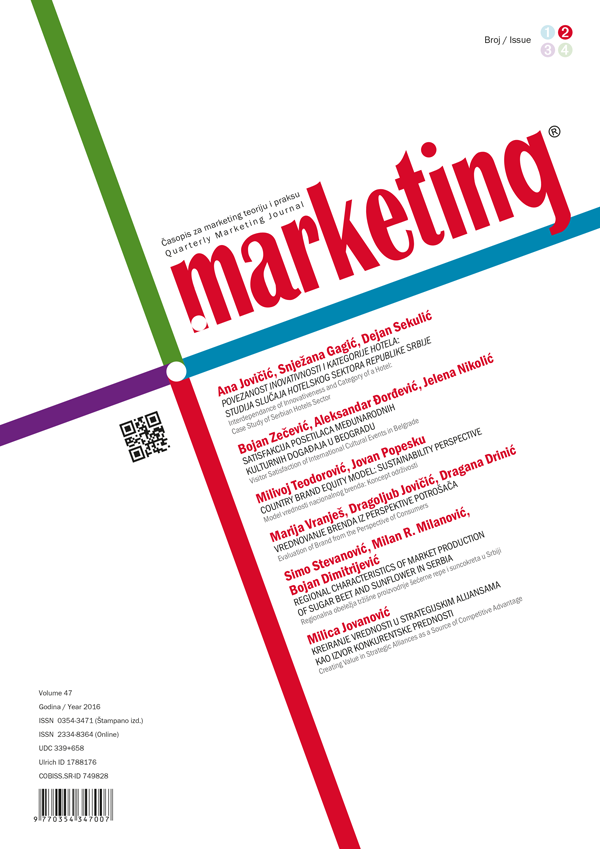
Povezanost inovativnosti i kategorije hotela: Studija slučaja hotelskog sektora Republike Srbije
Interdependance of Innovativeness and Category of a Hotel: Case Study of Serbian Hotels Sector
Apstrakt
Uvođenje novina u poslovanje kritični je faktor kvaliteta smeštajne ponude i uspeha hotela. Istraživanja su pokazala da postoji veza između kategorije i inovativnosti hotela, gde su se inovativnijim pokazali hoteli više kategorije. Cilj rada je da istraži vezu između kategorije i inovativnosti hotela, kao i da utvrdi razlike u pogledu inovativnosti i vrsta inovacija u zavisnosti od kategorije hotela. U istraživanju je učestvovalo 57 hotela u Srbiji, prve, druge i treće kate-gorije. Anketno istraživanje sprovedeno je na uzorku od 512 zaposlenih. Rezultati korelacione analize pokazali su da ne postoji povezanost između kategorije hotela i inovativnosti na ispitanom uzorku. Rezultati jednofaktorske analize varijanse pokazali su da su hoteli druge kategorije inovativniji u odnosu na hotele sa tri i pet zvezdica. Statistički značajne razlike između prve, druge i treće kategorije pronađeni su u slučaju inovacija procesa, inovacija proizvoda ili usluga i upravljačkih inovacija. Hotelska industrija u Republici Srbiji svoj dalji razvoj trebalo bi da usmeri ka prilagođavanju novoj tražnji i savremenim trendovima, posebno u pogledu komunikacija, uvođenja novih tehnologija i ekoloških standarda, zbog čega bi ulaganje u inovacije trebalo da bude strategijska opcija svih hotela bez obzira na kategoriju kojoj pripadaju.
Abstract
The introduction of the innovation in business is critical factor of the quality of the accommodation offer and the success of the hotel. Studies have shown that there is a relationship between category and innovativeness of the hotel, where the higher categories hotels have been shown to be more innovative. The aim of this study is to explore the relationship between category and innovativeness of the hotel, as well as to determine the differences in terms of innovation and types of innovation, depending on the category of the hotel. The study included 57 hotels of the first, second and third category in Serbia. The survey was conducted on a sample of 512 employees. The results of correlation analysis showed there is no corelation between the category and innovativeness of the hotel. The results of ANOVA showed that the second category hotels are more innovative than hotels with three and five stars. Statistically significant differences between the first, second and third category were found in the case of process innovation, product and service innovation and management innovation.
Reference
- Ansoff, H.I. and Stewart, J.M. (1967). Strategies for a technology based business, Harvard Business Review, 45(6), 71–83.
- Arnold, E. Price, L. and Zinkhan, G. (2004). Consumers, New York: McGraw-Hill.
- Čačić, K. (2010). Poslovanje hotelskih preduzeća, Beograd: Univerzitet Singidunum.
- Chang, S. Gong, Y. and Shum, C. (2011). Promoting innovation in hospitality companies through human resource management practices. International Journal of Hospitality Management, 30(4), 812-818.
- Cohen, J. (1988). Statistical Power Analysis for the Behavioral Sciences, 2nd ed. Hillsdale, New Jersey: Erlbaum.
- Damanpour, F. (1991). Organizational innovation: A meta-analysis of effects of determinants and moderators. Academy of Management Journal, 34(3), 555−590.
- Darr, E. D. Argote, L. and Epple, D. (1995). The acquisition, transfer, and depreciation of knowledge in service organizations: Productivity in franchises. Management science, 41(11), 1750-1762.
- European Commission (1996). Green Paper on Innovation. European Commission, Luxembourg.
- Hensens, W. (2015). The future of hotel rating, Journal of Tourism Futures, 1(1), 69 – 73.
- Higgins, K.T. (1998). The value of customer value analysis, Marketing Research, 10, Winter/Spring, 39-44.
- Hine, D. Ryan, N. (1999). Small service firms —Creating value through innovation. Managing Service Quality, 9(6), 411−422.
- Hjalager, A. M. (2010). A review of innovation research in tourism. Tourism Management, 31(1), 1-12.
- Hogan, J. S. Soutar N. G. McColl-Kennedy R. J. and Sweeney C. J. (2011). Reconceptualizing Professional Service Firm Innovation Capability: Scale Development. Industrial Marketing Management, 40 (8), 1264-1273.
- Horwath Consulting, Zagreb i Ekonomski fakultet, Beograd, (2005). Strategija razvoja turizma Srbije do 2015 .godine, Beograd.
- Jones, P. (1996). Managing hospitality innovation. The Cornell Hotel and Restaurant Administration Quarterly, 37(5), 86-95.
- Koc, T. (2007). Organizational determinants of innovation capacity in software companies. Computers and Industrial Engineering, 53(3), 373–385. 17. Kosar, LJ. (2002). Hotelijerstvo: teorija i praksa, Viša hotelijerska škola, Beograd.
- Martinez-Ros, E. and Orfila-Sintes, F. (2009). Innovation activity in the hotel industry. Technovation, 29(9), 632-641.
- Milgrom, P. and Roberts, J. (1995). Complementarities and fit strategy, structure, and organizational change in manufacturing. Journal of accounting and economics, 19(2), 179-208.
- Nasution, H. N. Mavondo, F. T. Matanda, M. J. and Ndubisi, N. O. (2011). Entrepreneurship: Its relationship with market orientation and learning orientation and as antecedents to innovation and customer value. Industrial Marketing Management, 40(3), 336-345.
- Nunnally, J. C. (1978). Psychometric Theory. New York: McGraw-Hill.
- Orfila-Sintes, F. and Mattsson, J. (2009). Innovation behavior in the hotel industry. Omega, 37(2), 380-394.
- Orfila-Sintes, F. Crespi-Cladera, and Martinez-Ros, E. (2005). Innovation activity in the hotel industry: evidence from Balearic hotels. Tourism Management, 26(6), 851–865.
- Ottenbacher, M., Gnoth, J. and Jones, P. (2006). Identifying determinants of success in development of new high-contact services: Insights from the hospitality industry. International Journal of Service Industry Management, 17(4), 344-363.
- Pikkemaat, B. and Peters, M. (2006). Towards the measurement of innovation—A pilot study in the small and medium sized hotel industry. Journal of Quality Assurance in Hospitality and Tourism, 6(3-4), 89-112.
- Pikkemaat, B. (2008). Innovation in small and medium-sized tourism enterprises in Tyrol, Austria. Entrepreneurship and Innovation, 9(3), 187–197.
- Pindžo, R. i Barjaktarović, L. (2013). Analiza modaliteta finansiranja i podsticanja kvaliteta ugostiteljskog smeštaja u Republici Srbiji, U Zbornik radova međunarodnog naučno-stručnog skupa Hotelska kuća 2013, 183 – 201.
- Porter, M.E. (1996). What is strategy? Harvard Business Review, 44, 61-78.
- Pravilnik o uslovima i načinu obavljanja ugostiteljske delatnosti, načinu pružanja usluga, razvrstavanju ugostiteljskih objekata i minimalno tehničkim uslovima za uređenje i opremanje ugostiteljskih objekata (Službeni glasnik RS, broj 41/10, 103/10 i 48/12 i 99/12)
- Spiteri, J. and Dion, P. (2004). Customer value, overall satisfaction, end-user loyalty, and market performance in detail intensive industries. Industrial Marketing Management, 33(8), 675-687.
- Stanković, Lj. i Đukić, S. (2009). Marketing strategija orijentisana na vrednost, QMJ – Quarterly Marketing Journal, 40(2), 73-78.
- Statistical Office of the European Communities. (2005). Oslo manual: Guidelines for collecting and interpreting innovation data (No. 4). Publications de l‘OCDE.
- Tajeddini, K. (2009) Perceptions of Learning among Swiss Watch Managers, Journal of Workplace Learning, 21(7), 525-537.
- Tisdell, C. (Ed.) (2000). The Economics of Tourism. Massachussets: Edward Elgar Publishing Limited.
- Woodruff, R.B. (1997). Customer value: the next source for competitive advantage, Journal of the Academy of Marketing Science, 25(2), 139-53.