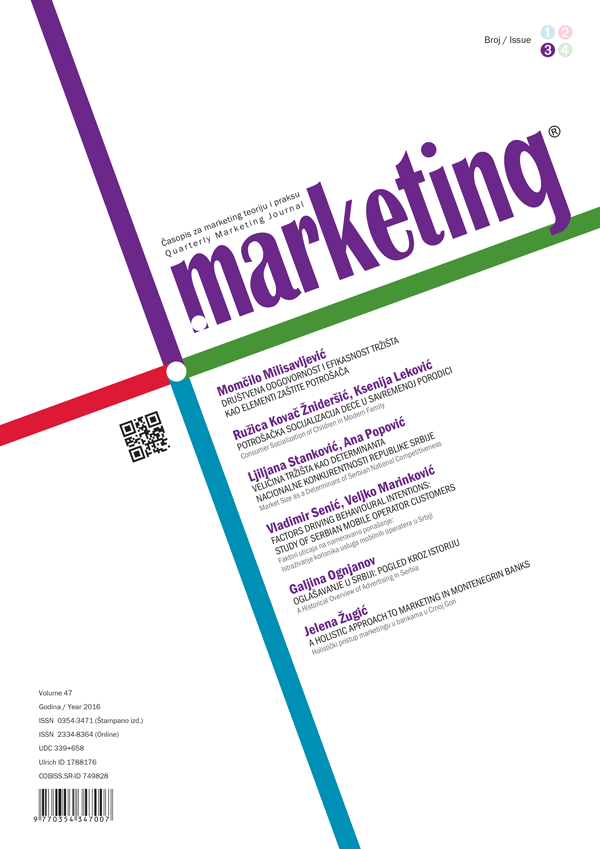
Potrošačka socijalizacija dece u savremenoj porodici
Consumer Socialization of Children in Modern Family
Apstrakt
Istraživanje predstavljeno u radu temelji se na ponašanju jednog specifičnog segmenta potrošača –specifičnog po svojim psihološkim, ali i ekonomskim karakteristikama – segmentu dece potrošača. Shodno tome, predmet istraživanja predstavlja uticaj koji deca potrošači ostvaruju u procesu odlučivanja o porodičnoj kupovini u okviru savremenih porodica. Cilj rada ogleda se u ukazivanju na značaj porodice kao osnovnog faktora potrošačke socijalizacije dece u okviru koje deca ostvaruju sve značajnije, aktivno učešće u donošenju kupovnih odluka. Rezultati sprovedenog empirijskog istraživanja potvrdili su nalaze i tvrdnje stranih autora po pitanju uticaja koje deca potrošači ostvaruju u okviru porodica.
Abstract
The research presented in this paper is based on the behavior of a specific segment of consumers – specific for its psychological as well as economic characteristics – segment of kids (children) as consumers. Therefore, the kids as consumers and their influence in family decision making process, in the framework of modern („new“) families, are the subject of this research. The aim of the paper is analyising the importance of family as the main driving force of consumer socialization of children in which kids achieve more significant and active participation in making purchasing decisions. Results of empirical research, presented in this paper, are in line with the findings of foreign authors with regards to influence of children in family decision making.
Reference
- Babin, B.J., Harris, E.G. (2012). Ponašanje potrošača. Beograd: Data Status.
- Beatty, S., Talpade, S. (1994). Adolescent Influence in Family Decision Making: A Replication with Extension. Journal of Consumer Research. 21(2). 332-341.
- Caruana, A., Vassallo, R. (2003). Children’s perception of their influence over purchases: the role of parental communication patterns. Journal of Consumer Marketing. 20 (1). 55-66.
- Christensen, P.H., Prout, A. (2002). Working with ethical symmetry in social research with children. Childhood. 9 (4), 477-497.
- Clarke, L., Joshi, H. (2005). Children’s changing families and family resources. in Jensen, A., McKee, L. (eds). Children and the Changing Family: Between Transformation and Negotiation. (15-26). Routledge.
- Dotson, M., Hyatt, E. (2005). Major influence factors in children’s consumer socialization. Journal of Consumer Marketing. 22 (1). 35-42.
- Dotson, M., Hyatt, E. (2000). A comparison of parents’ and childrens’ knowledge of brands and advertising slogans in the United States: implications for consumer socialization. Journal of Marketing Communications. 6 (4). 219-230.
- Ekstrom, K. (2007). Parental consumer learning or ’keeping up with the children. Journal of Consumer Behaviour. 6 (4). 203-217.
- Filipović, J. (2010). Mali kupci, veliko tržište. Beograd: Zavod za udžbenike.
- Flurry, L. (2007). Children’s influence in family decision-making: Examining the impact of the changing American family. Journal of Business Research. 60. 322-330.
- Flurry, L., Burns, A. (2005). Children’s influence in purchase decisions: a social power theory approach. Journal of Business Research. 58. 593-601.
- Geuens, M.G., Mast, G., Pelsmacker, P.D. (2002). Children‘s Influence on Family Purchase Behavior: The Role of Family Structure. Asia Pacific Advances in Consumer Research. 5. 130-135.
- Giddens, A. (2001). Sociology. Polity Press.
- Kaur, P., Singh, R. (2006). Children in Family Purchase Decision Making in India and the West: A Review. Academy of Marketing Science Review. 2006 (8), 1-30.
- Kesić, T. (2006). Ponašanje potrošača. Opinio.
- Khattri, V. (2011). Marketers in Kids’ Gloves. BVIMR Management Egde. 4 (2), 83-94.
- Labrecque, J., Ricard, L. (2001). Children’s influence on family decision-making: a restaurant study. Journal of Business Research. 54.173-176.
- Lawlor, M., Prothero, A. (2011). Pester power – A battle of wills between children and their parents. Journal of Marketing Management. 27 (5-6). 561-581.
- Maričić, B. (2011). Ponašanje potrošača. Beograd: Centar za izdavačku delatnost Ekonomskog fakulteta.
- Martin, E. (2006). The Influence of Children on Family Purchasing: Capturing Children‘s Voices. Doctoral Thesis. University of Aberdeen.
- McNeal, J. (1999). The Kids Market: Myths and Realities. Paramount Market Publishing.
- Milić, A. (2007). Sociologija porodice – kritika i izazovi. Čigoja štampa.
- Neeley, S., Coffey, T. (2007). Understanding the „four-eyed, four-legged“ consumer: a segmentation analysis of U.S. moms. Journal of Marketing Theory and Practice. 15 (3). 251-261.
- Norgaard, M., Bruns, K., Christensen, P., Mikkelsen, M. (2007). „Children‘s influence on and participation in the family decision process during food buying. Young Consumers. 8 (3). 197-216.
- Rice, C. (2001). Razumevanje potrošača. Beograd: PS „Grmeč“.
- Roedder, D. (1999). Consumer Socialization of Children: A Retrospective Look at Twenty-Five Years of Research. Journal of Consumer Research. 26 (3). 183-213.
- Rose, G., Boush, D., Shoham, A. (2002). Family communication and children’s purchasing influence: a cross-national examination. Journal of Business Research. 55, 867-873.
- Schiffman, L.G., Kanuk, L.L., Hansen, H. (2008). Consumer Behaviour – a European Outlook. Pearson Education Limited.
- Siegel, D., Coffey, T., Livingston, G. (2004). The Great Tween Buying Machine. Dearborn Trade Publishing. A Kaplan Professional Company.
- Thomson, E., Laing, A. (2003). The Net Generation“: Children and Young People, the Internet and Online Shopping. Journal of Marketing Management. 19 (3-4). 491-512.
- Tinson, J., Nancarrow, C., Brace, I. (2008). Purchase decision making and the increasing significance of family types. Journal of Consumer Marketing. 25 (1). 45-56.
- Ward, S. (1974). Consumer Socialization. Journal of Consumer Research. 1 (2). 1-14.
- Wimalasiri, J. (2004). A cross-national study on children’s purchasing behavior and parental response. Journal of Consumer Marketing. 21 (4). 274-284.