
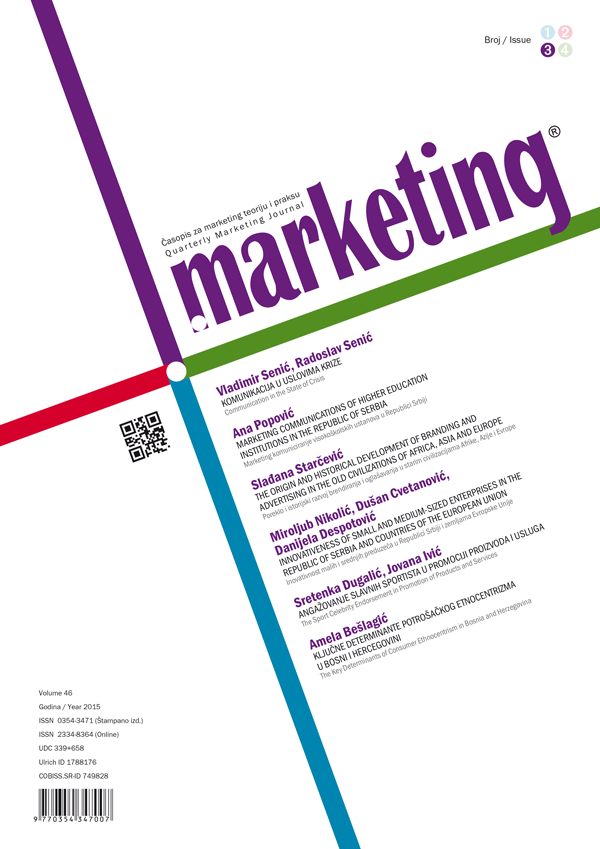
Poreklo i istorijski razvoj brendiranja i oglašavanja u starim civilizacijama Afrike, Azije i Evrope
The Origin and Historical Development of Branding and Advertising in the Old Civilizations of Africa, Asia and Europe
Apstrakt
Razvoj brendiranja i oglašavanja oduvek su bili međusobno uslovljeni. Cilj ovog istraživanja je da se utvrdi poreklo i prikaže istorijski razvoj brendiranja i oglašavanja u starim civilizacijama Afrike, Azije i Evrope. Primenjen je istorijski metod istraživanja. Predstavljeni su novi dokazi o primeni različitih oblika brendiranja, oglašavanja i drugih promotivnih aktivnosti u starom veku. Pokazalo se da je društveni razvoj nametnuo potrebu za označavanjem predmeta i promotivnim aktivnostima. Praksa je bila slična u svim starim civilizacijama, bez obzira na različite vremenske periode. Postojala su dva tipa brendiranja i oglašavanja: komercijalno i lično. Funkcije brendiranja i oglašavanja bile su raznovrsne i slične njihovim savremenim funkcijama.
Abstract
The development of branding and advertising has always been mutually conditioned. The goal of this research is to determine the origin and show historic development of branding and advertising in the ancient civilizations of Africa, Asia and Europe. The historical method of research was used. New evidence on various means of branding, advertising and other promotional activities application in the ancient history is presented. What was found is that social development imposed a need for marking of goods and promotional activities. It was done in a similar manner in all ancient civilizations, regardless of different time span. There were two types of branding and advertising: commercial and personal. The roles of branding and advertising were versatile and similar to their contemporary roles.
Reference
- Adkins, L. and Adkins, A. R. (2004), Handbook to Life in Ancient Rome, Facts on File Inc., New York
- Agnihotri, V.K. (2010), Indian History, Allied Publishers, New Delhi
- Allen, S. (2000), Kings and Queens of Egypt, In Heilbrunn Timeline of Art History – Metropolitan Museum of Art, http://www.metmuseum.org/toah/hd/kqae/hd_kqae.htm, accessed: June 21, 2015.
- Almquist, E. and Roberts, K.J. (2000), “A Mindshare Manifesto: Common Misconceptions Squander the Power of the Modern Brand“, Mercer Management Journal, Vol. 12, No. 12, p. 9-20.
- Andrews, E. (2013), 8 Things You May Not Know About Hammurabi’s Code, http://www.history.com/news/history-lists/8-things-you-may-not-know-about-hammurabis-code, accessed: May 25, 2015.
- Anttiroiko, A. (2014), The Political Economy of City Branding, Routledge, New York
- Arens, W. F. (2006), Contemporary Advertising, 10th edition, McGraw-Hill/Irwin Publishing, New York
- Aruz, J. and Wallenfels, R. eds. (2003), Art of the First Cities: The Third Millennium B.C. from the Mediterranean to the Indus, Metropolitan Museum of Art, New York
- Bahn, P. G. (2000), The Atlas of World Archaeology, Checkmark Books, New York
- Bastos, W. and Levy, S. J. (2012), „A History of the Concept of Branding: Practice and Theory“, Journal of Historical Research in Marketing, Vol. 4, No. 3, p. 347-368.
- Belmonte, J. A. and González-García, C. (2010), “Antiochos‘s Hierothesion at Nemrud Dag Revisited: Adjusting the Date in the Light of Astronomical Evidence“, Journal for the History of Astronomy, Vol. 41, No. 4, p. 469-481.
- Boundless, Art of the Qin Dynasty, https://www.boundless.com/art-history/textbooks/boundless-art-history-textbook/chinese-and-korean-art-before-1279-14/the-qin-dynasty-96/art-of-the-qin-dynasty-459-5603/, accessed June 4, 2015.
- Bourbon, F. ed. (2004), Drevne civilizacije: Velike kulture svijeta, The original title – Lost Civilizations: Rediscovering the Great Cultures of the Past, Mozaik Knjiga, Zagreb
- Brodribb, G. (1992), “Roman Bricks and Tile“, Phoenix, Vol. 46, No. 1, p. 82-84.
- Bullard, S. B. (2014), ”Book Review: Writing on the Wall – The First 2,000 Years of Social Media, by Tom Standage“, Journalism & Mass Communication Quarterly, Vol. 91, No.1, p. 182-216.
- Business Dictionary. Propaganda definition. http://www.businessdictionary.com/definition/propaganda.html, accessed April 22, 2015.
- Cavaliere, B. ed. (2007), Art of the Classical World in the Metropolitan Museum of Art, Metropolitan Museum of Art, New York
- Cheng, H. and Chan, K.W. eds. (2009), Advertising and Chinese Society: Impacts and Issues. Copenhagen Business School Press, Copenhagen
- Classical Art History, Northern Mesopotamia, http://classicalarthistory.weebly.com/ancient-near-eastern.html, accessed September 15, 2015.
- Codella, K. C. (2007), Achaemenid Monumental Gateways at Pasargadae, Susa and Persepolis, Ph.D. dissertation, University of California, Berkeley
- Cultural China, Shang Dynasty (1600 BC – 1046 BC), http://history.cultural-china.com/en/182History6983.html, accessed August 2, 2015.
- Danesi, M. (2008), Why it Sells, Rowman and Littlefield Publishers, Lanham
- Daniels, P. T. and Bright, W. eds. (1996), The World’s Writing Systems, Oxford University Press, New York
- De Cheratony, L. (2012), From Brand Vision to Brand Evaluation: The Strategic Process of Growing and Strengthening the Brand, Routledge, New York
- Deshpande, M.N. (1973), “Sir Tashi Namgyal Memorial Lectures 1973: Buddhist Art of Ajanta and Tabo“, Bulletin of Tibetology, Vol.10, No.3, p. 1-44.
- Dhavalikar, M.K. (1968), ”New Inscriptions from Ajanta“, Art Orientalis, No. 7, p. 147-153.
- Dobran, F. ed. (2006), Vesuvius: Education, Security and Prosperity, Elsevier, Amsterdam
- Eby, A., Origin and Development of Writing in Mesopotamia: An Economic Interpretation, in Internet Ancient History Sourcebook – Fordham University, https://www.academia.edu/462398/The_Origin_and_ Development_of_Writing_in_Mesopotamia_An_ Economic_Interpretation, accessed June 6, 2015.
- Eduljee, K.E. Persepolis: Capital of the Ancient Persian Achaemenian Empire: Stairway to the Gate of All Nations and Xerxes‘ Inscription, http://www.heritageinstitute.com/zoroastrianism/persepolis/persepolis2.htm, accessed January 31, 2015.
- Encyclopaedia Britannica, Indus Civilization, http://www.britannica.com/EBchecked/topic/286837/Indus-civilization, accessed September 12, 2015.
- Encyclopaedia Britannica, Shang Dynasty. http://www.britannica.com/EBchecked/topic/114678/Zhou-dynasty, accessed October 2, 2015.
- Encyclopedia Britannica, Zhou Dynasty. http://www.britannica.com/EBchecked/topic/538446/Shang-dynasty, accessed October 12, 2015.
- Ephesus Travel Guide, Marble Road, http://www. ephesustravelguide.com/agora-marble-street.html, accessed August 20, 2015.
- Ezejideaku, E. and Nkiruka Ugwu, E. (2010), “The Linguistics of Newspaper Advertising in Nigeria“, Language in India, Vol. 10, March, p. 1-17.
- Facts and Details, Persian Culture, Art, Governance and Life: Darius’s Palace in Persepolis, http://factsanddetails.com/world/cat56/sub371/item1976.html, accessed July 5, 2015.
- Faris, R. (2014), How to Build Brand Religion, http://www.brw.com.au/p/marketing/how_to_build_brand_ religion_JO7P8vSDMY5BSfip6oHazJ, accessed August 2, 2015.
- Feddersen, G. H. and Zucatto, G. E. (2013), “Infrastructure in Central Asia: Energy and Transportation Controversies“, UFRGS Model United Nations Journal, Vol.1, No.1, p. 159-181.
- Futrell, A. (2006), The Roman Games: A Sourcebook, Blackwell Publishing, Malden
- Galbi, D. (2009), Mass Media in Ancient Rome, http://purplemotes.net/2009/09/20/mass-media-in-ancient-rome/, accessed September 21, 2015.
- Garrison, M. B. and Cool Root, M. (2003), “Seals on the Persepolis Fortification Tablets: Images of Heroic Encounter“, Art Orientalis, Vol.33, p. 199-201.
- Goell, T. (1957), „The Excavation of the Hierothesion of Antiochus I of Commagene on Nemrud Dagh (1953-1956)“, Bulletin of the American Schools of Oriental Research, No. 147, p.4-22.
- Gohary, J. (2012), Abu Simbel, in Encyclopedia of Ancient History, http://onlinelibrary.wiley.com/doi/10.1002/9781444338386.wbeah15010/abstract;jse ssionid=65BE8EA13B43F4B82C35D1D05367954F.f03t01?deniedAccessCustomisedMessage=&userIsAuthe nticated=false, accessed October 1, 2015.
- Golder, P.N. (2010), “Historical Method in Marketing Research with New Evidence on Long-Term Market Share Stability”, Journal of Marketing Research, Vol. 37, May, p.156-172.
- Harper, P. O. (1971), „Origin and Influence, Cultural Contacts: Egypt, the Ancient Near East and the Classical World“, The Bulletin of the Metropolitan Museum of Arts, No. 29, p. 1-6.
- Harring, B.J.J., Kaper, O.E., Van der Moezel, K. and Soliman, D. (2011), Symbolising Identity: Identity Marks and Their Relation to Writing in New Kingdom Egypt, Ph.D. research project, Leiden University, Leiden
- Hayko, G. (2010), “Effects of Advertising on Society: A Literature Review“, Honohu, Vol. 8, p. 79-82.
- Hetch, J. (2008), Where Mesopotamians the First Brand Addicts?, http://www.newscientist.com/article/mg19826533.700-were-mesopotamians-the-first-brand-addicts.html, accessed October 13, 2015.
- Holleran, C. (2012), Shopping in Ancient Rome: The Retail Trade in the Late Republic and the Principate, Oxford University Press, Oxford
- Hornblower, S., Spawforth, A. and Eidinow E. eds. (2012), The Oxford Classical Dictionary, Oxford University Press, Oxford
- Hughey, J. R., Paschou, P., Drineas, P., Mastropaolo, D., Lotakis, D.M., Navas, P.A. Michalodimitrakis, M. and Stamatoyannopoulos, J.A. (2013), “A European Population in Minoan Bronze Age Crete“, Nature Communications, No. 4, p. 1-7.
- Jenks, C. ed. (1995), Visual Culture, Routledge, London
- Johns, C. (1963), „Gaulish Potters‘ Stamps“, Antiquaries Journal, Vol. 43, No. 2, p. 288–289.
- Joshua, M. (2011), Babylon, in Ancient History Encyclopedia, http://www.ancient.eu/babylon/, accessed June 27, 2015.
- Joshua, M. (2011), Uruk, in Ancient History Encyclopedia, http://www.ancient.eu/uruk/, accessed June 27, 2015.
- Jowett, G. S. and O’Donnell, V. (2012), Propaganda and Persuasion, 5th edition, Sage Publications, Thousand Oaks
- Kamya, T., Buddhist Monuments at Sanchi, http://www.kamit.jp/02_unesco/01_sanchi/san_eng.htm, accessed April 21, 2015.
- Keightley, D. N. ed. (1983), The Origins of Chineese Civilizations, University of California Press, London
- Keightley, D. N. (1978), Sources of Shang History: The Oracle-Bone Inscriptions of Bronze Age China, University of California Press, London
- Khan Academy, Sophilos: A New Direction in Greek Pottery. https://www.khanacademy.org/partner-content/british-museum/europe1/bm-ancient- greece/a/sophilos-a-new-direction-in-greek-pottery, accessed August 1, 2015.
- Khan, S. U. and Mufti, O. (2007), “The Hot History and Cold Future of Brands“, Journal of Managerial Sciencies, Vol. 1, No. 1, p. 25-87.
- Kleiner, F. (2010), Gardner’s Life Through the Ages: Non-Western Perspective, 13th edition, Cengage Learning, Wadsworth
- Köhne, E. and Ewingleben, C. (2000), Gladiators and Caesars: The Power of Spectacle in Ancient Rome, University of California Press, London
- LaFontaine, B. (2002), Gods of Ancient Egypt, Dover Publication, Mineola
- Landa, R. (2006), Desiging Brand Experience: Creating Powerful Integrated Brand Solutions, Thomson Delmar Learning, New York
- Leibtag, A. (2014), The Digital Crown: Winning at the Content on Web. Elsevier, Waltham
- Li, W. (2009), Chinese Writing and Calligraphy, University of Hawaii Press, Honolulu
- Lindsay, I. (2014), The History of Loot and Stolen Art: From Antiquity to Present Day, Unicorn Press, London.
- Lomas, K. ed. (2004), Greek Identity in a Western Mediterranean: Papers in Honor of Brian Shefton, Koninklijke Brill NV, Leiden
- Lydon, G. (2005), “Writing Trans-Saharan History: Methods, Sources and Interpretations Across the African Divide“, The Journal of North African Studies, Vol. 10, No. 3-4, p. 293-324.
- Lyons, C. L. and Papadopoulos, J. K. eds. (2002), The Archaeology of Colonialism, Getty Research Institute, Los Angeles
- Magelah, P. (2007), Totem, In The Encyclopedia of Earth, http://www.eoearth.org/view/article/156667/, accessed May 21, 2015.
- Manning, P. (2012), Semiotics of Drink and Drinking: Continuum Advances in Semiotics, Continuum International, London
- Massey, G. (2008), Totemism, Tattoo and Fetishism as Forms of Sign Language, Coismo, New York
- McDonough, J. and Egolf K. (2003), The Advertising Age Encyclopedia of Advertising, Fitzroy Dearborn Publishers, New York
- McIntosh, J. (2005), Ancient Mesopotamia: New Perspectives, ABC Clio, Santa Barbara
- McKie, R. (2012), Did Stone Age Caveman Talk to Each Other in Symbols, http://www.theguardian.com/science/2012/mar/11/cave-painting-symbols-language-evolution, accessed September 23, 2015.
- Milnor, K. (2014), Graffiti and the Literary Landscape in Roman Pompeii, Oxford University Press, Oxford
- Moore, K. and Reid S. (2008), “The Birth of Brands: 4000 Years of Branding History“, Business History, Vol.50, No.4, p. 419-432.
- Morris, I. ed. (1995), Clasical Greece: Ancient Histories and Modern Archeologies, Cambridge University Press, Cambridge
- Nordin, A.A.M, Kamaruddin, Z., Amer A. and Zulkepli, D.F. (2011), The Power of Sponsorship Program in Enhancing Brand Image: A Study on the Effectiveness of Kia Sponsoring the Fifa World Cup 2010. Proceedings of the 2nd International Conference on Business and Economic Research (ICBER), (ed. Mohd Bahtiar Othman) Langkavi Kedah, Malaysia, p. 177-196.
- O’Barr, W. M. (2005), A Brief History of Advertising in America, http://muse.jhu.edu/journals/advertising_and_society_review/v006/6.3unit02.html, accessed October 3, 2015.
- O’Shaughnessy, N. (2012), “The Death and Life of Propaganda”, Journal of Public Affairs, Vol. 12, No. 1, p. 29-38.
- Park, S.Y. and Lee, E. M. (2005), “Congruence Between Brand Personality and Self-Image, and the Mediating Roles of Satisfaction and Consumer-Brand Relationship on Brand Loyalty“, Asia Pacific Advances in Consumer Research, Vol. 6, p. 39-45.
- Phuoc, L. H. (2010), Buddhist Architecture, Grafikol, United States of America
- Reddi, N. C.V. (2009), Effective Public Relations and Media Strategy, PHI Learning Private Limited, New Delhi
- Reiter, V. (2008), New Brand Discovery in Modena: Ancient Roman Oil Lamp ‚Factory Town‘ Found, http://www.archeobologna.beniculturali.it/modena/viale_reiter_fornace/factory_08_en.htm , accessed May 25, 2015.
- Renfrew, C. (2008), Prehistory: The Making of the Human Mind, Modern Library, New York
- Retso, J. (2003), The Arabs in Antiquity: Their History from the Assyrians to the Umayyads, Routledge Curzon, New York
- Rixiang, Z., An, Z., Pott, R. and Hoffman, K.A. (2003), “Magnetostratigraphic Dating of Early Humans in China“, Earth Science Reviews, Vol. 61, No. 3-4, p. 341-359.
- Roberts, P. (2006), Ancient History: Book 2, Pascal Press, Glebe
- Ronnick, M. V. ed. (2006), The Works of William Sander Scarborugh: Black Classicist and Race Leader, Oxford University Press, New York
- Rozin, R. S. (2002), “The Branding Iron: From Cowboys to Corporations“, Journal of Brand Managemet, Vol. 10, No. 10, p. 4-7.
- Sandage, C. and Fryburger, V. (1963), Advertising Theory and Practice, Irwin Publishing, Homewood
- Shinde, V. and Willis, R.J. (2014), “A New Type of Inscribed Copper Plate from Indus Valley (Harappan Civilization)“, Ancient Asia, Vol.5, no.1, p. 1-10.
- Slanski, K. E. (2000), “Classification, Historiography and Monumental Authority: The Babylonian Entitlement Narûs (Kudurrus)“, Journal of Cuneiform Studies, Vol. 52, p. 95-114.
- Smith, L. (2013), The First Facebook Wall? New Study Reveals the Graffiti of Pompeii Could Have Been an Early Social Network, http://www.dailymail.co.uk/sciencetech/article-2262159/The-Facebook-wall-Pompeii-graffiti-early-social-network.html, accessed June 21, 2015.
- Somervill, B. (2010), Empires of Ancient Mesopotamia, Chelsea House, New York
- Starkweather, H. (2008), Exploring Ancient Ephesus, http://www.smithsonianmag.com/lifelists/exploring-ancient-ephesus-11753958/?no-ist, accessed October 15, 2015.
- Taylor, P. (1997), The Ancient Greeks, Heinemann Library, Crystal Lake
- Taylor, P. M. (2003), Munitions of the Mind: A History of Propaganda from the Ancient World to the Present Day, Manchester University Press, Manchester
- The British Museum, The Tomb of Lady Fu Hao, http://www.ancientchina.co.uk/staff/resources/background/bg7/bg7pdf.pdf, accessed August 25, 2015.
- The British Museum, Trade and Transport in Mesopotamia. http://www.mesopotamia.co.uk/trade/home_set.html, accessed August 24, 2015.
- Weiss, Z. (2014), Public Spectacles in Roman and Late Antique Palestine, Harvard University Press, Cambridge
- White, D., DeVries, K., Romano, D.G., Romano, I.B. and Stolyarik, Y. eds. (1995), The Ancient Greek World, University of Pensylvania Museum of Archeology and Antrophology, Philadelphia
- Willey, K. (2009), The Function of Reliefs and Statues at Abu Simbel, www.wou.edu/~kwilley/Ramses%20 II‘s%20Abu%20Simbel.doc, accessed September 12, 2015.
- Wilson, N. ed. (2006), Encyclopedia of Ancient Greece, Taylor and Francis Group, New York
- Wilson, J. and Xue, L. (2006), Imagined Enemies: China Prepares for Uncertain War. Stanford University Press, Stanford