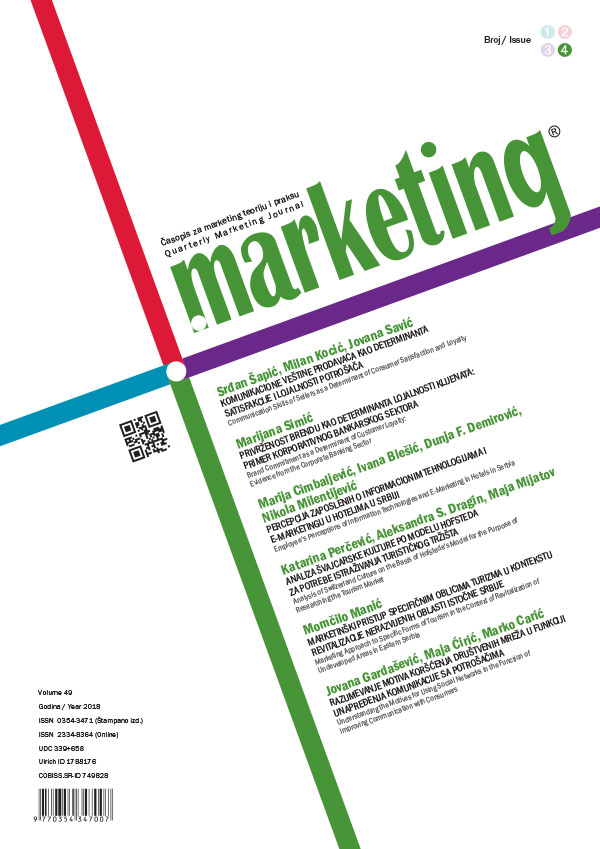
Percepcija zaposlenih o informacionim tehnologijama i e-marketingu u hotelima u Srbiji
Employee‘s Perceptions of Information Technologies and E-Marketing in Hotels in Serbia
Apstrakt
Već decenijama unazad, hotelska industrija se susreće sa tehnološkim inovacijama koje podižu njen kvalitet usluga. Tehnologije su u hotelskoj industriji redefinisale i iznova formulisale proces usluga na inovativan način. Ovaj rad ima za cilj da utvrdi stanje i nivo poznavanja trenutno dostupnih sistema informacionih tehnologija (IT), da utvrdi razumevanje budućih IT mogućnosti i uslova u hotelskoj industriji od strane zaposlenih, ali i da se stekne razumevanje IT zahteva u bliskoj budućnosti iz njihove perspektive. Rad se takođe bavi pitanjima koja se tiču upotrebe e-marketinga uopšte, kao i u interakciji sa klijentima. Istraživanje je pokazalo da u hotelima u Srbiji postoji pozitivan stav kada je u pitanju upotreba i značaj informaciono komunikacionih tehnologija. Osim toga, vlada i razumevanje za buduće IT mogućnosti i uslove u hotelskoj industriji od strane zaposlenih. Na polju e-marketinga rezultati su pokazali da je moguće izdvojiti tri bitna faktora koja utiču na sprovođenje e-marketing prakse u hotelskoj industriji. Time je potvrđena pretpostavka da su hoteli u Srbiji prihvatili i da svoje poslovanje dosta baziraju na e-marketingu.
Abstract
For decades, the hotel industry has turned to technological innovations that raise its quality of services. In hotel industry, technologies redefined and re-formulated the service process in an innovative way. This paper aims to determine the status and level of knowledge of the currently available information technology (IT) systems, to determine the understanding of future IT opportunities and conditions in the hotel industry by employees, but also to gain understanding of IT requirements from their perspective in the near future. The paper also deals with issues related to the use of e-marketing in general, as well as in interaction with clients. The research has shown that hotel employees in Serbia have a positive attitude when it comes to the use and importance of information communication technologies. In addition, there is understanding for future IT opportunities and conditions in the hotel industry by employees. In the field of e-marketing, the results showed that it is possible to distinguish three important factors that influence the implementation of e-marketing practices in the hotel industry. This confirms the assumption that hotels in Serbia have accepted and that their business is to a certain extent based on e-marketing.
Reference
- Albee, A. (2010). eMarketing strategies for the complex sale. New York: Marketing Interactions, Inc.
- Andrlić, B. (2007). Primjena e-marketinga u turizmu. Poslovna izvrsnost, 1(2), 85-97.
- Andrlić, B., & Ružić, I. (2010). Effect of e-marketing on consumer behavior in hospitality. In J. Perić (Ed.), Proceedings of the Tourism & Hospitality Management Conference (pp. 692-706), Opatija: Faculty of Tourism and Hospitality Management.
- Beldona, S., & Cobanoglu, C. (2007). Importance-performance analysis of guest technologies in the lodging industry. Cornell Hotel and Restaurant Administration Quarterly, 48(3), 299-312. DOI: 10.1177/0010880407304023
- Boyd, D. M., & Ellison, N. B. (2007). Social network sites: Definition, history, and scholarship’. Journal of Computer-Mediated Communication, 13(1), 210-230. DOI:10.1111/j.1083-6101.2007.00393.x
- Brewer, P., Kim, J., Schrier, T., & Farrish, J. (2008). Current and Future Technology Use in the Hospitality Industry. Las Vegas: American Hotel and Lodging Association (AH&LA), University of Nevada.
- Chan, N. L., & Guillet, B. D. (2011). Investigation of Social Media Marketing: How Does the Hotel Industry in Hong Kong Perform in Marketing on Social Media Websites?. Journal of Travel & Tourism Marketing, 28(4), 345-368. DOI: 10.1080/10548408.2011.571571
- Chen, W. C. (2011). Technology Base Self Service (doctoral dissertation). University of Nevada. Las Vegas.
- Chung, T., & Law, R. (2003). Developing a performance indicator for hotel websites. International Journal of Hospitality Management, 22, 119–125. DOI: 10.1016/S0278-4319(02)00076-2
- Clark, S. (2012). NCR adds NFC to hotel check-ins. Retrieved from:
http://www.nfcworld.com/2012/05/21/315795/ncr-adds-nfc-hotel-checkins/ - Coates-Conroy, J. (2008). Self-Check-In Security. Retrieved from:
http://www.airport-technology.com/features/feature1510/. - Collins, G. R., & Cobanoglu, C. (2008). Hospitality information technology: Learning how to use it (6th ed.). Dubuque, IA: Kendall/Hunt
- Dobrača, I. (2011). Primjena e-mail marketinga u hotelijerstvu. Praktični menadžment, 2(1), 121–127.
- El-Gohary, H. (2012). Factors affecting E-Marketing adoption and implementation in tourism firms: An empirical investigation of Egyptian small tourism organizations. Tourism Management, 33(5), 1256–1269. DOI: 10.1016/j.tourman.2011.10.013
- Erdem, M., Schrier, T., & Brewer, P. (2009). Guest empowerment technologies. Tools that give hotel quests personal control over their stay in a hotel. Journal of Hospitality Finance and Technology Professionals, 24(3), 17–19.
- Fuchs, M., Tuta, M & Höpken, W. (2008). Adoption of E-mail marketing in the Hotel Sector. Information and Communication Technologies in Tourism (part 9), 279-290. DOI: 10.1007/978-3-211-77280-5_25
- Hasan, B. (2003). The influence of specific computer experiences on computer self-efficacy beliefs. Computers in Human Behavior, 19, 443–450.
- Holzner, S. (2009). Facebook marketing: Leverage social media to grow your business. Indianapolis, IL: Que Publishing.
- Hoteli u Srbiji. Retrieved 22, January 2018, from http://hoteli.cu.rs/
- Kasavana, M. L. (2008). The convergence of self-service technology. Hospitality Upgrade, 122-128.
- Law, R. & Hsu, C. (2006). Importance of Hotel Website Dimensions and Attributes: Perceptions of Online Browsers and Online Purchasers. Journal of Hospitality & Tourism Research, 30(3), 295-312.
- Lončarić, D. & Radetić, N. (2015). The implementation of e-marketing in the hotel industry: the case of Istra country. Zbornik Veleučilišta u Rijeci, 3(1), 15-26.
- Lee, S. C., Barker, S., & Kandampully, J. (2003). Technology, service quality, and customer loyalty in hotels: Australian managerial perspectives. Managing Service Quality: An International Journal, 13(5), 423-432.
- Leung, X. Y, Bai, B & Stahura, K. (2015). The marketing effectiveness of social media in the hotel industry: a comparison of facebook and twitter. Journal of Hospitality and Tourism Research 39(2), 147-169.
- Madlmayr, G. & Scharinger, J. (2010). Neue Dimensionen von mobile Tourismusanwendungen durch Near Field Communication Technologie. In R. Egger, & M. Jooss (Eds), mTourism – Mobile Dienste im Tourismus (pp. 75-88), Wiesbaden: Gabler.
- Magnini, V., Honeycutt, E., & Hodge, K. (2003). Data mining for hotel firms: Use and limitations. Cornell Hotel and Restaurant Administration Quarterly, 44(2), 94-105.
- Mowat, B. (2010). Social media: Is it a friend, or foe?Canadian Travel Press, 42(26), 8-22.
- Nezamabad, M. (2011). The Impact and Benefits of Internet on Marketing Mix Australian. Journal of Basic and Applied Sciences, 5, 1784-1789.
- Oronsky, C. R., & Chathoth, P. K. (2007). An exploratory study examining information technology adoption and implementation in full-service restaurant firms. International Journal of Hospitality Management, 26(4), 941-956.
- Parets, R.T. (2004). Hotel rooms are high-tech homes away from home. International Gaming & Wagering, 25(3), 26-31.
- Peštek, A., & Čičić, M. (2010). Practical aspects of e- marketing application in tourism development in Bosnia and Herzegovina. In V. Trivun, D. Djonlagić & E. Mehic (Eds.), Proceedings of International Conference ICES – Economic Development Perspectives of SEE Region in Global Recession Context (pp. 112-126), Sarajevo: School of Economics and Business.
- Primorac, D., Smoljić, M., & Bogomolec, M. (2012). Internet use as a part of business strategy in small hotels in the Republic of Croatia. Megatrend Review, 9(1), 317-328.
- Radojević, T., & Radović N. (2012). Strategijsko upravljanje kompanijama u hotelijerstvu primenom informacionih sistem [Strategic management of companies in hotel industry using information systems]. In D. Pavlović, T. Radojević & N. Radović (Eds.), Zbornik radova sa naučnog skupa: Uloga savremenih informacionih tehnologija u poslovanju hotelskih preduzeća i turističkih agencija [The role of modern information technologies in hotel companies and travel agencies business] (str. 18-30), Subotica: Ekonomski fakultet.
- Sekaran , U. (2003). Research methods for business: a skill building approach. (4th Ed). New York: John Wiley and Sons.
- Serlen, B. (2010). Hilton looks to take mobile applications to the next level. Hotel Business, 4.
- Sigala, M. (2003). Developing and Benchmarking Internet Marketing Strategies in the Hotel Sector in Greece. Journal of Hospitality and Tourism Research, 27, 375-401.
- Siguaw, J.A., Enz, C. A., & Namasivayam, K. (2000). Adoption of Information Technology in U.S. Hotels: Strategically Driven Objectives. Preuzeto [10.02.2019] sa Cornell University, School of Hotel Administration site: http://scholarship.sha.cornell.edu/articles/616
- Strategija razvoja turizma Republike Srbije za period od 2016. do 2025. godine (2016), Vlada Republike Srbije, Ministarstvo trgovine, turizma i telekomunikacija, Beograd.
- Yang, T., Kim, D., & Dhalwani, V. (2008). Social networking as a new trend in e-marketing. In L. Xu, A.Tjoa, & S. Chaudhry (Eds.), Research and Practical Issues of Enterprise Information System II (pp. 847-856), New York: Springer.
- Yang, H. O. & Fu, H.W. (2007). Creating and Sustaining Competitive Advantages of Hospitality Industry. Journal of American Academy of Business, 12(1), 113-119.
- Jin-zhao, W., & Jing, W. (2009). Issues, Challenges and Trends that Facing Hospitality Industry. Management Science and Engineering, 3(4), 53-58.
- Watkins, M. W. (2000). Monte Carlo PCA for Parallel Analysis [computer software]. State College, PA: Ed & Psych Associates.