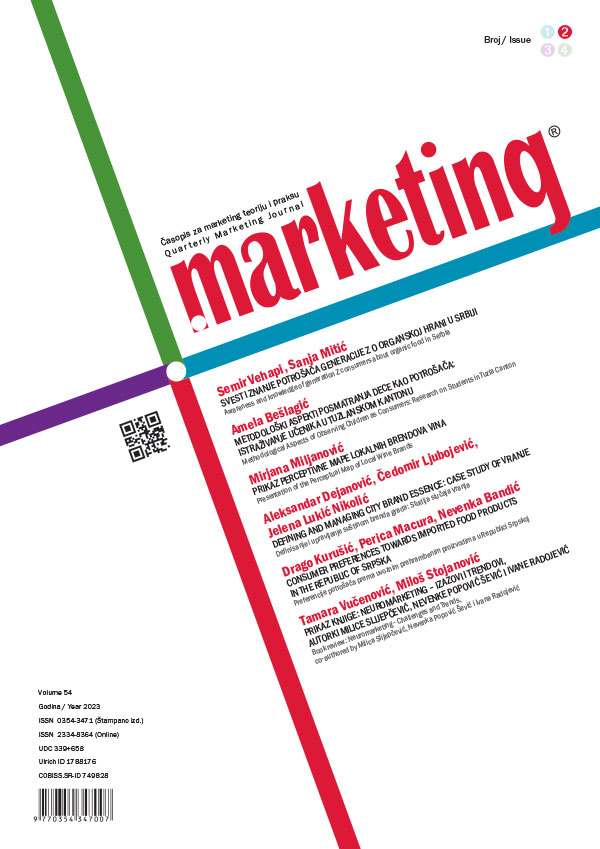
Metodološki aspekti posmatranja dece kao potrošača: istraživanje učenika u Tuzlanskom kantonu
Methodological Aspects of Observing Children as Consumers: Research on Students in Tuzla Canton
Apstrakt
Cilj istraživanja predstavlja utvrđivanje metodoloških i praktičnih problema u istraživanju navika u kupovini i marketinških aspekata dečijeg ponašanja. Istražen je odnos dece kao potrošača prema porodici, društvu i okolini. U radu se nastojalo objasniti način na koji deca kao potrošači percipiraju i razumeju namenu oglašavanja, a koje je povezano sa ponašanjem dece u kupovini. Ispitan je uticaj integrisanih marketinških komunikacija na navike u kupovini dece kao potrošača. Za testiranje postavljenih hipoteza korišćeni su primarni podaci. U okviru empirijskog istraživanja prikupljeni su podaci primjenom metode ispitivanja, na temelju višestepenog slučajnog uzorka. Podaci su prikupljeni uz prisutnost nastavnika i prethodnu saglasnost jednog od roditelja. Identifikovanjem i objašnjenjem ključnih determinanti ponašanja dece kao potrošača, uočilo se da deca žele sami učestvovati u izboru onoga što im se nudi. Medijsko oglašavanje ne može se više obraćati njihovim roditeljima, jer se situacija promenila zbog toga što su deca najčešće ta koja utiču na konačnu kupovinu. Tuzlanski kanton, kao geografsko područje provedenog istraživanja, predstavlja ograničenje ispitivanja, te bi se kao preporuka za dalja istraživanja posmatranja dece kao potrošača trebalo fokusirati na područje cele Bosne i Hercegovine.
Abstract
The aim of the research is to determine methodological and practical problems in researching shopping habits and marketing aspects of children‘s behavior. The relationship of children as consumers towards family, society and the environment was investigated. The paper tried to explain the way in which children as consumers perceive and understand the purpose of advertising, which is related to children‘s shopping behavior. The impact of integrated marketing communications on the buying habits of children as consumers was examined. Primary data were used to test the set hypotheses. As part of the empirical research, data were collected using the test method, based on a multi-stage random sample. The data were collected with the presence of the teacher and the prior consent of one of the parents. By identifying and explaining the key determinants of children‘s behavior as consumers, it was observed that children want to participate themselves in the choice of what is offered to them. Media advertising can no longer address their parents, because the situation has changed due to the fact that children are usually the ones who influence the final purchase. Tuzla Canton, as the geographical area of the conducted research, represents a limitation of the research, and as a recommendation for further research into the observation of children as consumers, it should be focused on the entire area of Bosnia and Herzegovina.
Reference
- Bamfo, B. A., Kraa, J. J., Asabere, P, Atarah, B. A. (2019). Effect of television adverts on children’s purchase behaviour: Evidence from Ghana, Cogent Business & Management, 6, 1 – 13.
- Banik, S., Dhar, S. R. (2021), Effect of Advertisement on Children’s Purchase Intention: The Mediating Role of Advertisement Recall, The Journal of Management Theory and Practice, 2(2), 81 – 88.
- Boje koje utiču na kupovinu,
http://www.poslovni-savjetnik.com/superprodavac/boje-utjecu-na-kupovinu-vise-nego-mislite (preuzeto 10.09.2014) - Bradar, A. M., (2011), Dizajn ambalaže za djecu,
http://eprints.grf.unizg.hr/1211/1/DB21_Brdar_Ana-Marija.pdf (preuzeto 11.11.2015.) - Brečić, R. (2021). Važnost istraživanja djece u marketingu, Zbornik Ekonomskog fakulteta u Zagrebu, 19 (2), 89 – 110.
- Calvert, S. (2008). Children as consumers: Advertising and marketing, The Future of Children, 18 (1), 205 -234.
- Christensen, P. H., Prout, A., (2002). Working with ethical symmetry in social research with children, Childhood, (9) 4, 477-497.
- Clow, K. E., Baack, D. (2005). Integrated Advertising, Promotion & Marketing Communications, New Jersey: Pearson Education.
- Deca potrošači, http://edukacija.ekof.bg.ac.rs/tema-meseca.php?temaId=9 (preuzeto 13.02.2015)
- Filipović, J. (2009). Metodološki aspekti istraživanja ponašanja dece kao potrošača, Časopis Marketing, (42) 2, 97 – 104.
- Filipović, J., Ognjanov, G. (2011) Korišćenje medija od strane djece u Srbiji, Časopis Marketing, (40) 3, 139 – 144.
- Gobe, M. (2006). Emocionalno brendiranje, Beograd: Mass Media International.
- Ilišin, V. (2003). Mediji u slobodnom vremenu djece i komunikacija o medijskim sadržajima, Medijska istraživanja, (9) 2, 9 – 34.
- Jonauskaite, D., Parraga, C. A., Quiblier, M., Mohr, C.(2020). Feeling Blue or Seeing Red? Similar Patterns of Emotion Associations With Colour Patches and Colour Terms, i – Perception, 11 (1), 1 – 24.
- Kolika je kupovna moć djece | Već u dobi od tri godine imaju sposobnost da prepoznaju brendove, http://namirnice.ba/magazin/kolika-je-kupovna-moc-djece-vec-u-dobi-od-tri-godine-imaju-sposobnost-da-prepoznaju-brendove/ (preuzeto 18.10.2015.)
- Košir, M., Zgrabljić, N., Ranfil, R. (1999). Život s medijima, Zagreb Doron.
- Kovač, Ž. R., Leković, K. (2016). Consumer socialization of children in modern family. Marketing, 47(3), 181 – 190.
- Milanović, D. (2019). Djeca kao potrošački dionici u društvu, Doktorska disertacija, Sveučilište Josipa Jurja Strossmayera u Osijeku.
- Nashaat, H. H. (2017). Children‘s Consumer Perception, Routledge, London.
- Prodan, M. (2021). Boja u različitim kulturama, Završni rad, Sveučilište Jurja Dobrile u Puli, Pula.
- Purbasari, M. (2021). Warm colors, The encouragement, Humaniora, 12(1), 61 – 67.
- Roberts, D. F., Foehr, U. G., Rideont, V. J., Brodie, M. (1999). Kids & Media, http://www.kff.org/content/1999/1535/ (preuzeto 02.12.2015.)
- Sari, G. (2018). Effects of ads on children’s consumption behavior, Suleyman Demirel University Visionary Journal, 9(20), 53 – 67.
- Šramova, B. (2015). Marketing and Media Communications Targeted to Children as Consumers, Procedia – Social and Behavioral Sciences, (191), 1522 – 1527.
- Thapa, G. (2020). Impact of Television Advertisement on Children: Evidence from Nepal, Available at SSRN: http://dx.doi.org/10.2139/ssrn.3569041 (06.12.2023.)
- Tomić, S., Leković, K. (2017). Influence of basic demographic characteristics of children consumers on family travel purchase. Marketing, 48(3), 161 – 168.
- Tornetta S., Fox T., Blackbird J. How the psychology of color influences consumers, https://udel.edu/~rworley/e412/Psyc_of_color_final_paper.pdf, (preuzeto 05.05.2016)
- Zafar, U., Lodhi, R. N. (2018). Impact of Advertisement on Behaviour Of Children As Consumers, International Journal of Business Marketing and Management, 3(11), 20 – 29.