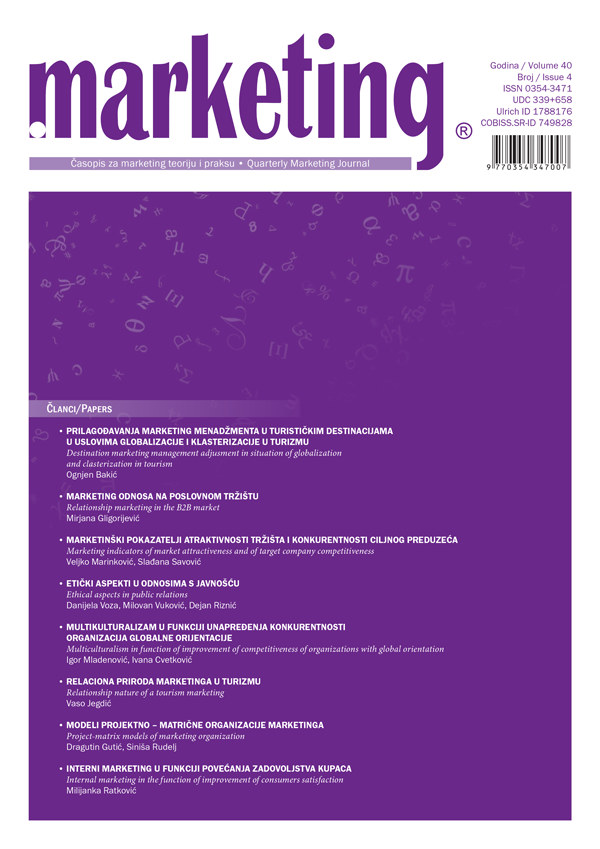
Marketing odnosa na poslovnom tržištu
Relationship marketing in the B2B market
Apstrakt
Kako tržište postaje konkurentski zahtevnije kompanije su suočene sa potrebom promene svog marketinškog pristupa. Transakcioni marketinški pristup je zamenjen marketingom odnosa, u cilju povećanja tržišnog učešća, kroz uspostavljanje odnosa sa najvažnijim kupcima, tj. kroz implementaciju koncepta upravljanja ključnim kupcima. U ovom radu će biti predstavljen koncept upravljanja ključnim kupcima. U poslednjem delu rada, poseban osvrt će biti učinjen na efekte implementacije koncepta upravljanja ključnim u smislu potencijalnih prednosti i nedostataka.
Abstract
As markets turned more and more competitive, companies had to change their marketing approach. From transactional marketing they are shifting to relationship marketing, trying to increase market share by focusing on their most important customers, implementing the concept of key account management). In this paper we tend to introduce the concept of key account management. In final section of this paper we will analyze effects of implementation of key account management, in terms of potential benefits and cautions.
Reference
- Cornell E., (2001), “Rationale for Strategic Accounts“, Velocity Q2, p. 8
- Gligorijević M., (2009), Poslovni marketing, CID, Ekonomski fakultet, Beograd,
- Gosselin D.P., Bauwen G.A., (2006), „Strategic account management: customer value creation through customer alignment“ Journal of Business&Industrial Marketing, Vol. 21, No. 6, pp. 376-385
- Hut, M. D. and T. W. Speh. (2010), Business Marketing Management: B2B. South Western, Cengage Learning.
- Ivens, B. S. and C. Pardo, (2007), “Are key account relationships different? Empirical results on supplier strategies and customer reactions”, Industrial Marketing Management, Vol. 36, pp. 470-482.
- Kempeners, A. M. and H. VanderHart, (1999), “Designing account management organizations”, Journal of Business & Industrial Marketing, Vol. 14, No. 4, pp. 310-327.
- Kotler P., Keller K.L., (2009), Marketing Management, Pearson Education
- McDonald M., Millman T. and Rogers B., (1997), “Key Account Management: Theory, Practice and Challenges”, Journal of Marketing Management, Vol. 13, pp. 737-757.
- Millman, T. and K. Wilson, (1996), “Developing key account management competences”, Journal of Marketing Practice, Vol. 2, No. 2, pp. 7-17.
- Millman T., Wilson K., (1999), “Processual issues in key account management: underpinning the customer-facing organization”, Journal of Business & Industrial Marketing, Vol. 14, No. 4, pp. 328-337.
- Ojasalo J., (2002), „Key Account Management in information-intensive services“, Journal of Retailing and Consumer Services, Vol. 9, pp. 269–276.
- Webster, F. E. (1991), Industrial Marketing Strategy. New York: John Wiley & Sons
- Wengler S., Ehret M., Saab S., (2006),“Implementation of Key Account Management: Who, why, and how?An exploratory study on the current implementation of Key Account Management programs”, Industrial Marketing Management, Vol. 35, pp. 103-112.