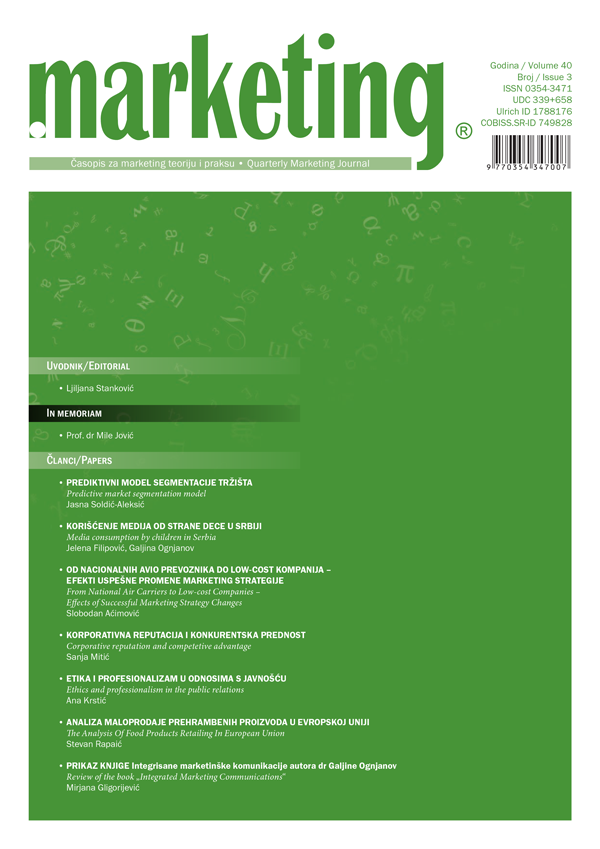
Korišćenje medija od strane dece u Srbiji
Media consumption by children in Serbia
Apstrakt
Cilj ovog rada jeste pružanje uvida u to koliko deca koriste različite medije u Srbiji. Segmentacija dece (ispitanika) napravljena je prema njihovoj starosti, polu i mestu boravka. Rezultati istraživanja pokazali su da postoje značajne razlike u korišćenju tri od ukupno četiri ispitivana medija (televizija, radio, štampa, internet), u zavisnosti od toga da li deca pripadaju starijoj ili mlađoj starosnoj kohorti. Takođe su otkrivena variranja u korišćenju štampe i radija u zavisnosti od pola dece, dok se čini da i dečaci i devojčice podjednako koriste televiziju i internet. Na kraju, rezultati pokazuju i značajne varijacije u upotrebi interneta prema tome u kom gradu deca žive. Iako se uzorak sastojao od više od 700 ispitanika, ne može se smatrati sasvim reprezentativnim za celu zemlju, s obzirom na to da je istraživanje sprovedeno samo u urbanim područjima zemlje. Najveća vrednost ove studije nalazi se u činjenici da se bavila ispitivanjem teme koja je sasvim neistražena u Srbiji (a i u ostalim tranzicionim zemljama iz regiona), pa se smatra da će poslužiti kao osnova za buduća istraživanja, kao i da će pomoći marketinškim stručnjacima da donose kvalitetnije odluke o svojim aktivnostima vezanim za komunikaciju sa decom.
Abstract
The paper aims at providing an insight into media consumption among children in Serbia. A consumer survey was conducted to examine differences in children’s consumption of various advertising media based on their age, gender and hometown. The research findings revealed significant differences between the two age cohorts in the three out of four tested media categories (TV, print, radio and Internet). On the other hand, the research findings also revealed variations in consumption of radio and print media, and no difference in the consumption of television and Internet between boys and girls. Finally, the research findings suggested significant differences in the consumption of Internet among children living in five cities in Serbia. Though the sample included more than 700 children it cannot be considered strictly representative for the whole country since the survey was conducted in urban areas only. However, the greatest value of this study comes from the fact that the research was placed in Serbia as a transitional society of the Western Balkans which has been seriously underrepresented in the main body of contemporary marketing theory and research studies. Therefore, one of the main goals of this paper was to make a contribution to better understanding of local conditions that might influence marketing decisions when communicating with children as a specific target group on Serbian market.
Reference
- Bainbridge, J. (2004), „TV still most-consumed medium for kids“, B&T Weekly, Vol.54, No. 2477, str. 5.
- Bricolo, F., Gentile, D. A., Smelser, R. L., and G. Serpelloni. (2007), „Use of the Computer and Internet among Italian Families: First National Study“, CyberPsychology & Behavior, Vol.10, No. 6, str. 789-798.
- Brown, J.D., Childers, K.W., Bauman, K.E., and G.G., Koch. (1990), „The influence of new media and family structure on young adolescents’ television and radio use“, Communication Research, No. 17, str. 65-82.
- Christensen, P.G., and D.F., Roberts. (1998). It’s not only rock and roll: Popular music in the lives of adolescents, Hampton Press, Cresskill, NJ.
- Ćirić, T., Gertner, N., Dragutinović, Lj., Đurović, S. and D. Gecić, Kako odrastaju naša deca – Nastavak istraživanja „Uticaj medija, savremenih igara i igračaka na decu“, http://www.prosvetni-pregled.co.yu/, pristupljeno: 13.5.2008.
- Dotson, Michael J., and Hyatt, Eva M (2000), „A comparison of parents‘ and children‘s knowledge of brands and advertising slogans in the United States: implications for consumer socialization“, Journal of Marketing Communications, Vol. 6, No. 4, str. 219-230.
- Gerlsbeck, R. (2005), „The Internet life“, Marketing Magazine, Vol. 110, No.37, str.4.
- Holland, B. (1999), „Media Study Highlights Need For Parents‘ Role“, Billboard, Vol. 111, No. 49, str. 76.
- James, C. (2005), „The new media generation“, Brand Strategy, No. 189, str. 56-58.
- Kesić, T. and Z. Crvelin Kraljević. (2008), The effect of advertising on the behavior of children as consumers in Marketing Theory Challenges in Transitional Societies, (ed. Đurdjana Ozretic Dosen, Zoran Krupka, Vatroslav Skare) 2nd Scientific Conference, Zagreb, Croatia, str. 121-129
- Kline, S. (1993). Toys, TV, and Children’s Culture in the Age of Marketing. Verso, London
- Krosnick, J. A., Anand, S. N. and S. P., Hartl. (2003),„Psychosocial Predictors of Heavy Television Viewing Among Preadolescents and Adolescents“, Basic & Applied Social Psychology, Vol. 25, No. 2, str. 87-110.
- Lafayette, J. (2004), „What Kids Watch, Want“, Television Week, Vol. 23, No. 15, str. 58-60.
- Lindstom, M., Seybold P.B. (2003), „Brandchild“, Kogan Page Limited, London
- Maričić, B. (2009), Ponašanje potrošača. 8. izdanje, CID Ekonomski fakultet, Beograd
- McNeal, J. U. (1999), „The Kids Market – Myths and Realities“, Paramount Market Publishing Inc., New York
- Oser, K. (2005), „Kids cram more hours into media day“, Advertising Age, Vol. 76, No, 46, str.31
- Roberts, D.F. (1999), Kids & Media @ the New Millennium, The Henry J. Kaiser Family Foundation, Menlo Park
- Roedder John, D. (1999), „Consumer Socialization of Children: A Retrospective Look at Twenty-Five Years of Research“, Journal of Consumer Research, Vol. 26, December, str. 183-213.
- Schenck-Yglesias, C. G. (1995), „Kids‘ radio is on the rise“, American Demographics, Vol. 17, No. 5, str. 22.
- Setlow, C. (2000). „When planning Web strategies, don‘t forget kids“, Discount Store News, Vol, 39, No. 7, str. 17.
- Siegel, D. L., T. J. Coffey and G. Livingston (2001), The Great Tween Buying Machine, Paramount Market Publishing, Inc., New York
- Wang, K. S. (1999). For kids, TV still tops media. Electronic Media, Vol. 18, No. 47, str. 3.
- Whitney, D. (2006). Kids get their way on TV. Advertising Age, Vol. 77, No. 11, str. S-4