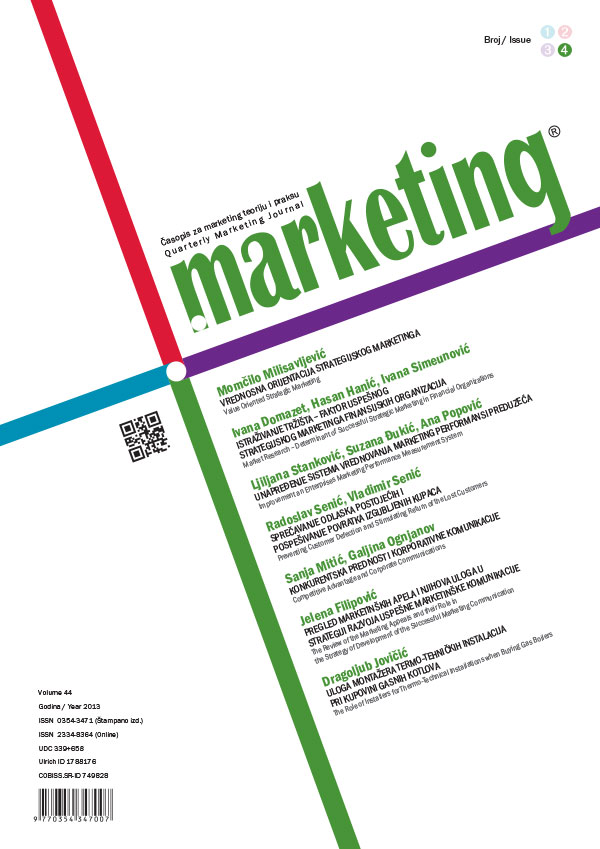
Konkurentska prednost i korporativne komunikacije
Competitive Advantage and Corporate Communications
Apstrakt
Strateški značaj korporativnih komunikacija i njihova ulogu u građenju konkurentske prednosti poslednjih godina sve više zaokuplja pažnju istraživača iz oblasti organizacije, menadžmenta, marketinga i odnosa s javnošću. Novija istraživanja o konkurentskoj prednosti ukazuju na rastući značaj tzv. mekih faktora među kojima se posebno ističe reputacija. Sam koncept reputacije u znatnoj je meri povezan sa konceptom stejkholdera. Reputacija se gradi komunikacijom sa stejkholderima. Time se naglašava značaj korporativnih komunikacija za postizanje konkurentnosti kompanija. U radu se akcenat stavlja na stratešku konkurentnost i naglašava neophodnost uspostavljanja veze između strategije, reputacije i korporativnih komunikacija.
Abstract
Strategic importance of corporate communications and its role in the development of competitive advantage has attracted interest of numerous researchers in the fields of organization, management, marketing and public relations. Recent studies particularly emphasise the growing importance of soft factors, such as reputation in the development of competitive advantage. Concept of reputation is strongly connected with stakeholder theory, which stresses the importance of corporate communications for competitive advantage of firms. The paper focuses on competitive advantage and the link among strategy, reputation and corporate communications.
Reference
- Blowfield, M. & Frynas, J. (2005), „Setting new agendas: critical perspectives on Corporate Social Responsibility in the developing world“, International Affairs, Vol. 81, No.3, str. 499-513.
- Brammer, S. & Pavelin, S. (2006), „Corporate Reputation and Social Performance: The Importance of Fit“, Journal of Management Studies, Vol. 43, No. 3, str. 435-455.
- Brealey, A. R., Myers, C. S. & Marcus, J. A. (2001), Fundamentals of Corporate Finance. McGraw-Hill, Irwin, New York.
- Burke, T. (1998), „Risks and reputations: The economics of transaction costs“, Corporate Communications, Vol.3, No.1, str. 5–10.
- Capoozzi, L. (2005), „Corporate Reutation: Our Role in Sustaining and Building a Valuable Asset“, Journal of Advertising Reserach, Vol.45, No.3, str. 290-293.
- Caspar, R. & Steen, T. (2004), „The Impact of Corporate Reputation on Performance: Some Danish Evidence“, European Management Journal, Vol.22, No.2, str.201-210.
- Zabala, I., Panadero, G., Gallardo, L., Amate, C.M., Sanchez-Galindo, M., Tena, I. & Villalba, I. (2005),„Corporate Reputation in Professional Services Firms: Reputation Management Based on Intellectual Capital Management“, Corporate Reputation Review, Vol.8, No.1, str. 59–71.
- Cravens, K., Goad, E. & Sridhar, R. (2003), „The Reputation Index: Measuring and Managing Corporate Reputation“, European Management Journal, Vol.21, No.2, str.201-212.
- Das, T. K. & Teng, B. S. (2001), „A Risk Perception Model of Alliance Structuring“, Journal of International Management, No.7, str. 1–29.
- Dentchev, A.N. & Heene A. (2004), „Managing the Reputation of Restructuring Corporations: Sending the Right Signal to the Right Stakeholder“, Journal of Public Affairs, Vol.4, No.1, str. 56-72.
- Donaldson, T. & Preston, L.E. (1995), „The Stakeholder Theory of the Corporation Concepts, Evidence and Implications“, Academy of Management Review, Vol.20, No.1, str. 65–91.
- Dowling, G. & Moran, P. (2012), „Corporate Reputations: Built in or Bolted on?“ California Management Review, Vol.54, No.2, str. 25-42.
- Dowling, G. (2004a), „Corporate Reputations: Should You Compete on Yours?“, California Management Review, Vol.46, No.3, str. 19-36.
- Dowling, G.R. (2004), „Journalists’ Evaluations of Corporate Reputations“, Corporate Reputation Review, Vol.7, No.2, str. 196–205.
- Drobis, D. R. (1991), „Competitive Thinking for Competitive Advantage“, Public Relations Quarterly, Vol. 36, No.3, str.9-12.
- El-Diraby, T.E. Costa, J. & Singh, S. (2006), „How do contractors evaluate company competitiveness and market attractiveness? The case of Toronto contractors“, Canadian Journal of Civil Engineering, Vol.33, No.5, str. 596-608.
- Flatt, S. J. & Kowalczyk, S. J. (2008), „Creating Competitive Advantage Through Intangible Assets: The Direct And Indirect Effects Of Corporate Culture And Reputation“, Advances in Competitiveness Research, Vol.16, No.1, str. 13-30.
- Fombrun, C. & Van Riel C. (2003), Fame&Fortune: How Successful Companies Build Winning Reputations. Financial Times, Prentice Hall, New Jersey.
- Fombrun, C. & Shanley, M. (1990), What’s In a Name? Reputation Building and Corporate strategy. Academy of Management Journal, Vol.33, No.2, str. 233-258.
- Forman, J.& Argenti, P. A. (2005), „How Corporate Communication Influences Strategy Implementation, Reputation and the Corporate Brand: An Exploratory Qualitative Study“, Corporate Reputation Review, Vol.8, No.3, str. 245–264.
- Freeman, R. E. & McVea, J. (2001), „A Stakeholder Astrroach to Strategic Management“, Darden Business School Working Paper No. 01-02. Retrieved from: http://ssrn.com/abstract=263511
- Hawabhay, B.B., Abratt, R. & Peters, M. (2009), „The Role of Corporate Communications in Developing a Corporate Brand Image and Reputation in Mauritius“, Corporate Reputation Review, Vol. 12, No.1, str. 3–20.
- Heugens, P. (2004), „Fame&Fortune: How Successful Companies Build Winning Reputations – Book Review“, Corporate Reputation Review, Vol.6, No.4, str. 390-395.
- Hitt, M.A., Hoskisson, R.E. & Harrison, J.S. (1991),„Strategic competitiveness in the 1990s: challenges and opportunities for U.S. executives“, Academy of Management Executive, Vol.5, No.2, str.7-22.
- Kumar, V., Jones, E., Venkatesan, R. & Leone, R. P. (2011), „Is Market Orientation a Source of Sustainable Competitive Advantage or Simply the Cost of Competing?“, Journal of Marketing, Vol.75, No.1, str.16-30.
- López,V. & Iglesias, S. (2010), „A Reputational–Performance Framework in an SME Context: Some Empirical Evidence from Spain“, The Irish Journal of Management, Vol.29, No.2, str. 35-66.
- McGuire, B. J., Schneeweis, T. & Branch, B. (1990),„Perceptions of Firm Quality: a Cause or Result of Firm Performance“, Journal of Management, Vol.16, No.1, str. 167–180.
- McMillan-Capehart, A., Aaron, J. & Cline, B. (2010),„Investor Reactions to Diversity Reputation Signals“, Corporate Reputation Review, Vol.13, No.3, str. 184-197.
- Michalisin, M., Kline M. D. & Smith, R.D. (2000), „Intangible Strategic Assets and Firm Performance: a Multi Industry Study of the Resource Based View“, Journal of Business Strategies, Vol. 17, No.2, str. 93–117.
- Mitić, S. (2005), Kreiranje i vrednovanje međunarodne poslovne reputacije. magistarska teza, Ekonomski fakultet, Beograd.
- Nielsen, B. (2003), „An Empirical Investigation of the Drivers of International Strategic Alliance Formation“, European Management Journal, Vol.21, No.3, str. 301-322.
- Obloj, T. & Obloj, K. (2006), „Diminishing Returns From Reputation: Do Followers Have a Competitive Advantage?“, Corporate Reputation Review, Vol. 9, No.4, str. 213–224.
- Roberts, W. P. & Dowling, R. G. (2002), „Corporate Reputation and Sustained Superior Financial Performance“, Strategic Managemant Journal, Vol.23, No.12, str. 1077-1094.
- Saxton, T. (1997), „The Effects of Partner and Relationship Characteristics on Alliance Outcomes“, Academy of Management Journal, Vol.40, No.2, str. 443-461.
- Sehgal, K. & Malati, N. (2013), „Employer Branding: A Potent Organizational Tool for EnhancingCompetitive Advantage“, IUP Journal of Brand Management, Vol.10, No.1, str.51-65.
- Sheehan, N. & Stabell, C. (2010), „Reputation as a Driver in Activity Level Analysis: Reputation and Competitive Advantage in Knowledge Intensive Firms“, Corporate Reputation Review, Vol.13, No.3, str. 198–208.
- Suresh, K., Shivaram, R. & Violina, R. (2001), „Reputation Building and Performance: An Empirical Analysis of the Top-50 Pure Internet Firms“, European Management Journal, Vol.19, No.6, str.581-596.
- Varey, R. J. (1995), „A Model of Internal Marketing for Building and Sustaining a Competitive Service Advantage“, Journal of Marketing Management, Vol.11, No.1-3, str.41-54.
- Verčić, D., Zavrl, F., Rijavec, P., Ognjanov, G. & Brbaklić, A., (2004), Odnosi s medijima, Beograd, Medija Centar i Pristop.