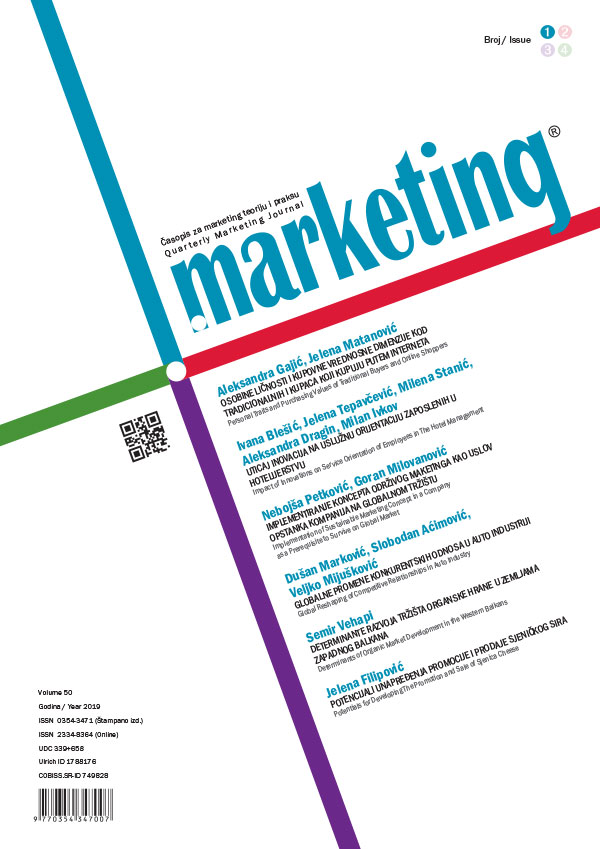
Implementiranje koncepta održivog maketinga kao uslov opstanka kompanija na globalnom tržištu
Implementation of Sustainable Marketing Concept in a Company as a Prerequisite to Survive on Global Market
Apstrakt
Savremena ekonomija, zasnovana na znanju i oličena u krupnom kapitalu i moćnim korporacijama, sposobnim da nameću svoje interese i uticaje širom sveta, razvija se u pravcu ukrupnjavanja, ujedinjavanja i rađanja novih oblika kolonijalizma i dominacije. Pojava novih tehnologija, novih proizvoda i tržišta, novi su izazovi kompanijama koje su prinuđene da preispituju marketing pristupe i prilagođavaju strategije zahtevima nestabilnog poslovnog okruženja. Održivi razvoj u globalnoj „ekonomiji planiranog zastarevanja proizvoda“ pretpostavlja preispitivanje etičkih i ekoloških principa kao i kretanje ka održivosti orijentisanoj na potrošače. Novi pristup polazi od potrošača i njegove brige za sebe, zajednicu i prirodu. Cilj ovog rada je, da se na bazi sistematizacije i analize naučnih saznanja iz relevatne naučne literature i savremene poslovne prakse, dokaže da u globalnoj ekonomiji perspektiva kompanija u sve većoj meri zavisi od njihove sposobnosti da inoviraju svoje marketing pristupe i odgovore na zahteve potrošača, društva i prirode. Kako bi došli do takvog dokaza, autori rada analiziraju: karakteristike globalne ekonomije, odnose između društvene odgovornosti kompanija i globalizacije, misiju održivog razvoja u globalnoj ekonomiji i ulogu odgovorne potrošnje.
Abstract
Modern economy, based on knowledge and embodied in large capital and powerful corporations capable of imposing their interests and influences throughout the world, is evolving towards the consolidation, unification and birth of new forms of colonialism and domination. The emergence of new technologies, new products and markets is a new challenge for companies that are forced to question their marketing approaches and adjust strategies in the unstable business environment. Sustainable development in the global „economy of planned product obsolescence“ presupposes the review of ethical and environmental principles as well as a shift towards consumer-oriented sustainability. The new approach starts from the consumer and his concern for himself, the community and nature. The aim of this paper is to prove, based on the systematization and analysis of scientific knowledge from relevant scientific literature and contemporary business practice, that in the global economy, companies’ perspectives increasingly depend on their ability to innovate in their marketing approaches and responses to consumer, society and nature demands. In order to reach such evidence, the authors analyze the characteristics of the global economy, the relationships between corporate social responsibility and globalization, the mission of sustainable development in the global economy and the role of responsible consumption.
Reference
- Achrol, R.S., Kotler, P. (2012), „Frontiers of the marketing paradigm in the third millennium.“ Journal of the Academy of Marketing Science, 40: 35–52.
- Andersen, A.R. (2002), „Marketing Social Marketing in the Social Change Marketplace.“ Journal of Public Policy and Marketing, 21(1): 3-14.
- Belz, F.M. and Peattie, K. (2012), Sustainability Marketing – A Global Perspective. 2nd edition, New York: John Wiley & Sons Inc.
- European Union, (2010), Smarter and Cleaner -Consuming and producing sustainability. Luxembourg: Publications Office of the European Union.
- Hanh, T.N. (1993), For a Future to be Possible: Commentaries on the Five Wonderful Precepts, Parallax Press, PO Box 7355, Berkeley, CA 94707,
http://dharma.ncf.ca/introduction/precepts/precept-5.html. (pristupljeno 16.03.2015). - Hindle, T. (2009), Triple bottom line, Online extra, The Economist, http://www.economist.com/node/14301663 (pristupljeno: 16.03.2015)
- Jones, M.C. (2003), „Talking about my Reputation.“ Brand Strategy, 173: 20-22.
- Kotler, P. (2011), „Reinventing Marketing to Manage the Environmental Imperative.” Journal of Marketing, 75 July: 132-135.
- Kotler, P., Keller, K.L. (2006), Marketing Management.(12th edition). New Jersey: Upper Saddle River, Prentice Hall.
- Kotler, P., Keller, K.L. (2009), Marketing Management. 13th Edition, New Jersey: Pearson Education International, Upper Saddle River.
- Martin, D., Schouten, J. (2012), Marketing in the Twenty-First Century. New York: Pearson Prentice Hall.
- Marylyn, C. (1993), „Global Corporate Philanthropy – Marketing Beyond the Call of Duty?“ European Journal of Marketing, 27(2): 46-58.
- Miles, M., Munilla, L. (1995), „The Eco Marketing Orientation: An Emerging Business Philosophy“ u: Environmental Marketing: Strategies, Practice, Theory, and Research, editors: Michael Jay Polonsky, Alma T Mintu-Wimsatt, PhD, The Haworth Press, Binghamton, NY, 23-37.
- Report of the World Commission on Environment and Development: Our Common Future, Oslo, 20 March 1987, www.un-documents.net/our-common-future.pdf (pristupljeno 17.03.2015)
- Sheth, J.N., Parvatiyar, A. (1995), „Ecological Imperatives and the Role of Marketing.“ u: Environmental Marketing: Strategies, Practice, Theory, and Research, editors: Michael Jay Polonsky, Alma T Mintu-Wimsatt, PhD, The Haworth Press, Binghamton, NY.
- Sheth, J.N., Sethia, N.K., Srinivas, S. (2011), „Mindful consumption: a customer-centric approach to sustainability.“ Journal of the Academy of Marketing Science 39: 21–39.
- Sheth, N.J., Sisodia, S.R. (2007), „Raising Marketing’s Aspirations.“ Journal of Public Policy & Marketing, 26(1) Spring: 141-143.
- Stanković, Lj., Đukić, S., Popović, A. (2012a), „Institutional platform for the sustainable consumption in European Union and Serbia“ u: Proceedings from International Scientific Conference Serbia and the European Union (Eds: Aranđelović, Z., Marinković, S.), pp. 145-158, October 18th 2012, Niš: Faculty of Economics, University of Niš, ISBN: 978-86-6139-061-6
- Stanković, Lj., Đukić, S., Popović, A. (2012b), „Razvoj društveno odgovornog marketinga“. Marketing, 43: 181-190.
- Stanković, Lj., Stošić, D. (2008), „Unapređenje konkurentske prednosti razvojem društveno odgovornog marketinga“. Ekonomske teme 3: 17-29.
- Vasiljev, S. (2011), „Održivi razvoj, konkurentnost i male ekonomije“. Banja Luka: Svarog, 3: 37-43.
- Witkowski, H.T. (2005), „Antiglobal Challenges to Marketing in Developing Countries: Exploring the Ideological Divide.“ Journal of Public Policy & Marketing, 24(1) Spring: 7-23.